
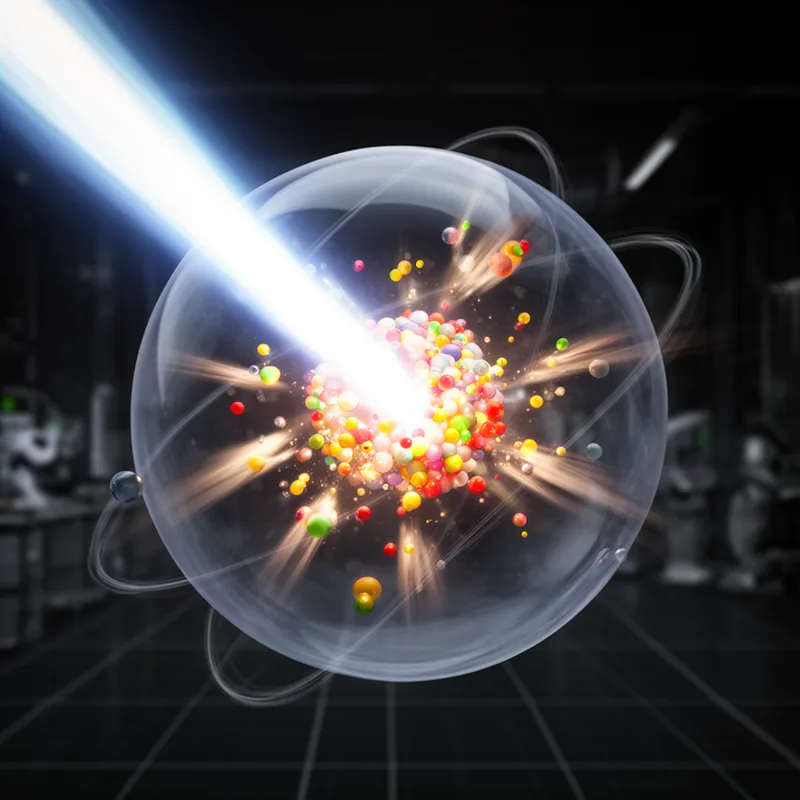
photoproduction
- noun
- /ˌfoʊtoʊprəˈdʌkʃən/
- Specialized
- Their research on photoproduction revealed how photons can generate particles when they collide with atomic nuclei.
- photoproduction of pions
- photoproduction cross sections
Examples
-
Scientists study photoproduction to understand how high-energy light can create new particles in atomic collisions.
-
There is also an electric-quadrupole contribution to the photoproduction of the d(1232), which contributes a different dependence to the cross section.
Academic text (2005) -
The polarization of Brookhaven National Laboratory's LEGS ladon beam has been determined with high accuracy by measuring the azimuthal asymmetry of neutral-pion photoproduction on helium.
Academic text (2005) -
The interaction of high-energy photons leads to the photoproduction of particle-antiparticle pairs during the experiment.
Synonyms
A process in which a particle of light makes the central part of an atom split into smaller parts
Surface Forms
Morphology
photoproduction = production (semi-transparent) = photo + produce + tion
The meaning is compositionally built from photo- 'light' plus production, but the particle-physics sense is highly specialized and not fully predictable for a general learner.
Etymology
Photoproduction begins with photo- meaning 'light' and ends with production meaning 'making', like in photograph. So in physics photoproduction is light 'making' new particles when it hits an atom.

