
photoperiod


 1
7.6
- noun
- /ˈfoʊtəˌpɪr.i.əd/
- Specialized
- A limitation of our study is that we exposed larvae from all three populations not only to the temperature but also to the photoperiod conditions that are experienced at high latitudes.
- light photoperiod
- photoperiod and temperature
Examples
-
The growth temperature regime was also 20-30°C with a 14-hour photoperiod that coincided with the higher temperature.
Academic text (2014) -
All cultures were incubated under a 16-hour light photoperiod (6000 lux).
Academic text (2014) -
As a result, the northern photoperiod may have affected life history in central and southern populations differently than in northern populations.
Academic text (2018) -
Automatic light cycles for animal rooms were set for a 12 h light/dark photoperiod, with no twilight.
Academic text (1995) -
Moreover, when the southern populations of both species were reared at the northern photoperiod (as we did), this resulted in a somewhat lower growth rate compared to when the southern populations were reared at their local (southern) photoperiod; yet this effect was small.
Academic text (2018) -
Roh determined that Correa will flower when subjected to a long-day photoperiod, and it responds well to nitrogen fertilizer.
Academic text (1994) -
Lobsters 76-81 mm CL were kept in an open seawater system with ambient water temperatures and natural photoperiods.
Academic text (1999) -
Photoperiods differ between latitudes, and many species are adapted to local photoperiods to adjust their life history to the progress of the seasons (Bradshaw and Holzapfel 2006).
Academic text (2018) -
Cups were placed in incubators at 20°C and a photoperiod of 16:8 L:D with a light intensity of ca. 680 lux.
Academic text (2018) -
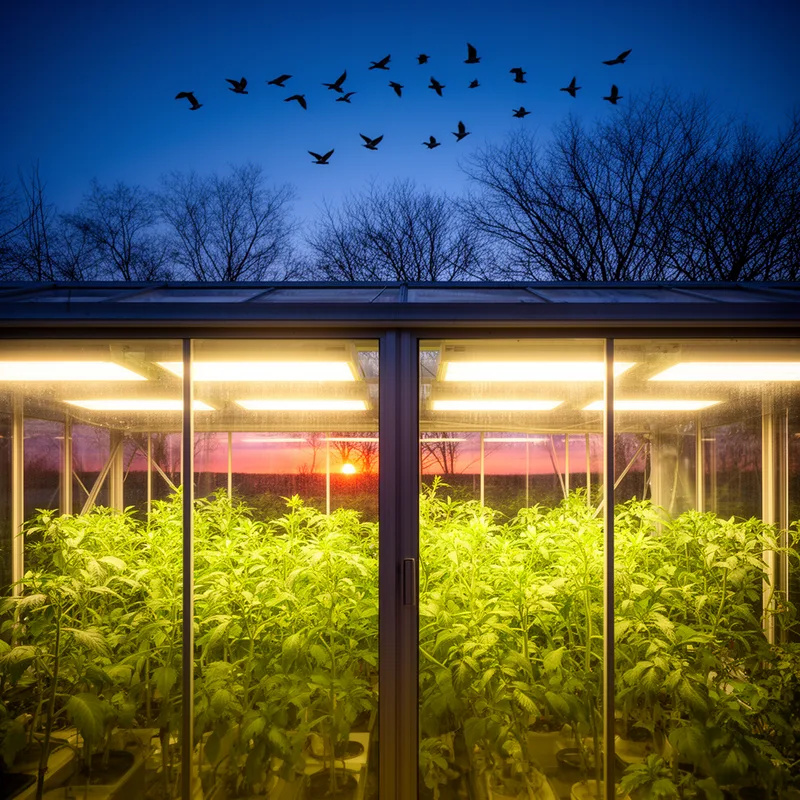
The growth of plants is heavily influenced by the photoperiod, as it determines how long they are exposed to light each day.
Surface Forms
Morphology
Etymology
Photoperiod combines photo- meaning 'light' (as in photograph) and period meaning 'time' or 'length'. So a photoperiod is the daily 'light time' an organism gets, which is why changes in day length affect growth and behavior.