
phonon
 1
9.9

- noun
- /ˈfoʊnɒn/
- Specialized
- Mechanical disturbances create isentropic pressure fluctuations that propagate as phonons with the speed of sound in water.
- electron-phonon
- phonon coupling
- phonon frequencies
Loading YouTube…
Watch on YouTubeSound is just the absorption of light, right, manifested in the form of phonons that carry mass.
- Sound is just the absorption of light, right, manifested in the form of phonons that carry mass.
Examples
-
This morning we detected a signal, a phonon burst that seems to have triggered these machines.
-
In the case of krypton on gold, phonons appear to be almost solely responsible for the dissipation of energy.
Academic text (1998) -
From the phonon dispersion curve, one could then infer much about the material properties.
Academic text (1994) -
Sound is just the absorption of light, right, manifested in the form of phonons that carry mass.
-
The chance of energy leaking out as phonons is conceivably high.
Academic text (2005) -
We shall concern ourselves only with acoustic phonons, whose frequencies extend from zero to approximately 10^12 Hz in most solids.
Academic text (1995) -
Among their activities, phonons govern the thermal properties of solids; they scatter electrons, relax spins, and mediate conventional superconductivity.
Academic text (1995) -
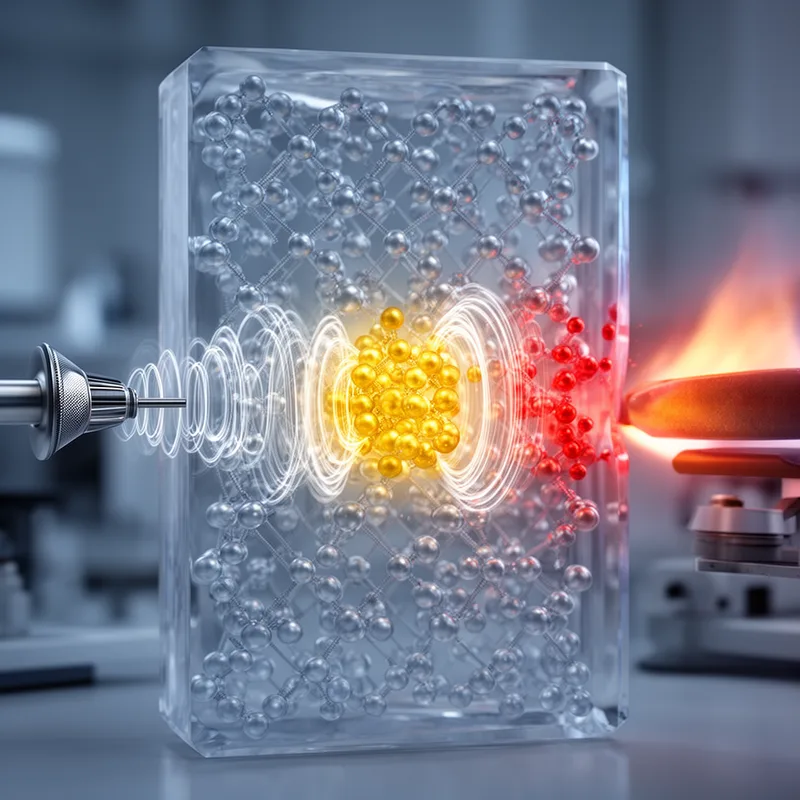
In solids, phonons travel through the material, carrying heat from one end to the other.
-
Researchers study phonons to understand how energy moves in different materials at a microscopic level.
-
Phonons can be thought of as the vibrational energy that helps sound travel through metal.
Surface Forms
Morphology
Etymology
Phonon comes from the Greek root phon- meaning 'sound' and the suffix -on, which scientists use for small particles as in electron. So a phonon is like a tiny 'sound particle' that carries vibration and heat through a solid.