
phlogiston
 1
9.9

- noun
- /fləˈdʒɪstən/
- Archaic
- According to the chemists of the 18th century, "evidence" showed that phlogiston existed.
- phlogiston theory
Examples
-
The experiments conducted to understand phlogiston ultimately led to the development of more accurate theories about fire.
-
The reason the Oxygen Theory won out over the phlogiston theory is that phlogiston was disproved.
Blog text (14) -
The more experiments that were performed using the phlogiston model, the more dubious it became as a theory.
Blog text (10) -
In this short time, it has been explained as phlogiston, a mysterious fluid created by fire, and as caloric, a material fluid flowing from hot to cold.
Academic text (2007) -
Yet the ether was later dropped and now appears as quaint as phlogiston or the Aristotelian humors.
Academic text (1996) -
And many good scientists cannot bring themselves to abandon an idea they have cherished even when the idea is clearly contradicted by additional data; for example, many clung to the phlogiston theory long after the evidence of Lavoisier's work, and many now cling to the AGW hypothesis despite the evidence of the 'missing hot spot.'
Blog text (30) -
You can't go back and wipe out the work of every researcher who thought they measured the presence of phlogiston, and you shouldn't erase the work of people who thought they discovered an unknown cause of disease—even if they were all later proved wrong.
Blog text (12) -
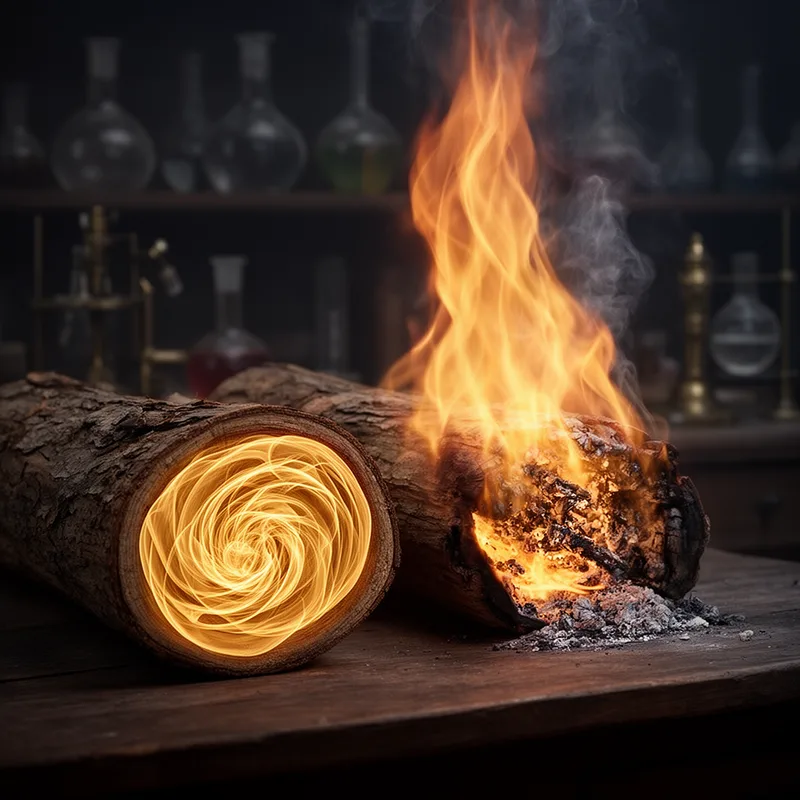
The phlogiston theory proposed that all combustible materials contained a substance called phlogiston that was released during burning.
-
In the past, scientists believed that phlogiston was emitted from burning wood, fueling their theories about combustion.
Surface Forms
Etymology
Phlogiston comes from the Greek word phlogistos (from the root phlog-), which means 'burnt' or 'flame'. So early chemists imagined phlogiston as a kind of 'fire-stuff' inside materials that was released when they burned, and that idea was later disproved.