

phishing scam
 1
4.8
1
4.8

- noun
- /ˈfɪʃɪŋ skæm/
- Texting
- I'm not about to hold people's hands to protect them against scary internet phishing scams.
- people fall for phishing scam
Examples
-
Training is the third way of protecting people from phishing scams.
Academic text (2012) -
The data is unreliable, as these are assumed to be from a phishing scam.
Blog text (23) -
There was a massive Google Doc phishing scam that went around where an e-mail was sent to people.
-
The best statistics you will get would only apply to the population of users who will fall for a phishing scam.
Blog text (23) -
The next call from your little phishing scam to this call center will make a spark across these wires.
-
I mean it would have meant anyone who'd had a phishing scam run on them would have been able to file a lawsuit.
Blog text (23) -
Studies by Wu et al. and Egelman et al. found passive warnings ineffective in protecting people from phishing scams, as they are easily missed.
Academic text (2012) -
Also, this is assuming the passwords are real (I sometimes spitefully enter false information into phishing scams).
Blog text (23) -
Dhamija et al. (2006) conducted one of the earliest studies investigating why people fall for phishing scams, asking participants to identify various websites as legitimate or fake.
Academic text (2012) -
Beware of the email that appears to be from your bank; it could be a phishing scam trying to steal your account information.
Synonyms
 294
3.0
294
3.0
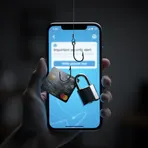
A dishonest plan to get money by tricking people
 9
4.2
9
4.2
Tricking people online to get their personal and bank details


 1
6.3
1
6.3
An illegal plan to get money by tricking people
How Deceptive

Surface Forms
Morphology
This is a straightforward modifier+noun composition: 'phishing' specifies the type of 'scam'. If a B1 learner knows 'phishing' (fraudulent online attempt to get personal data) and 'scam' (a deceptive scheme), they can readily infer it refers to a scam carried out by phishing. The pattern is a common, transparent noun phrase construction and is cross-linguistically familiar.
Etymology
Phishing scam comes from the idea of phishing being like fishing: a fisherman uses bait on a hook to catch fish, and a scammer sends fake emails or messages as bait to 'catch' people and their passwords. That's why phishing scams mean 'fake messages that try to steal personal information'.