
phage
 6
9.6
6
9.6

- noun
- /feɪdʒ/
- Specialized
- Appropriate procedures for testing the effect of human perspiration on phages were unavailable, so novel methods were employed.
- phage infectivity
- phage suspension
- treatment with phage
Loading YouTube…
Watch on YouTubeAnd there are viruses, five times as many viruses as bacteria that feed off them called phages, which also have a role in health.
- And there are viruses, five times as many viruses as bacteria that feed off them called phages, which also have a role in health.
- They brought a cocktail of three phages, one of which they found on a rotting eggplant from South Africa.
- What we and others are thinking about in in utilizing phages is that you know we have a huge unmet need in the microbiome field.
- So we're adding bacteria now that are resistant to phage things to CRISPR.
Examples
-
In the laboratory, researchers found that the phage successfully destroyed harmful bacteria.
-
Potentially useful phages are abundant wherever bacteria are naturally found, as in soil.
Academic text (2003) -
The results of this study suggest that some naturally occurring phages may be suitable for such applications.
Academic text (2003) -
Now, the use of phage for therapy against bacterial infections also reminds us that phage can be used to attack cancer.
-
And there are viruses, five times as many viruses as bacteria that feed off them called phages, which also have a role in health.
-
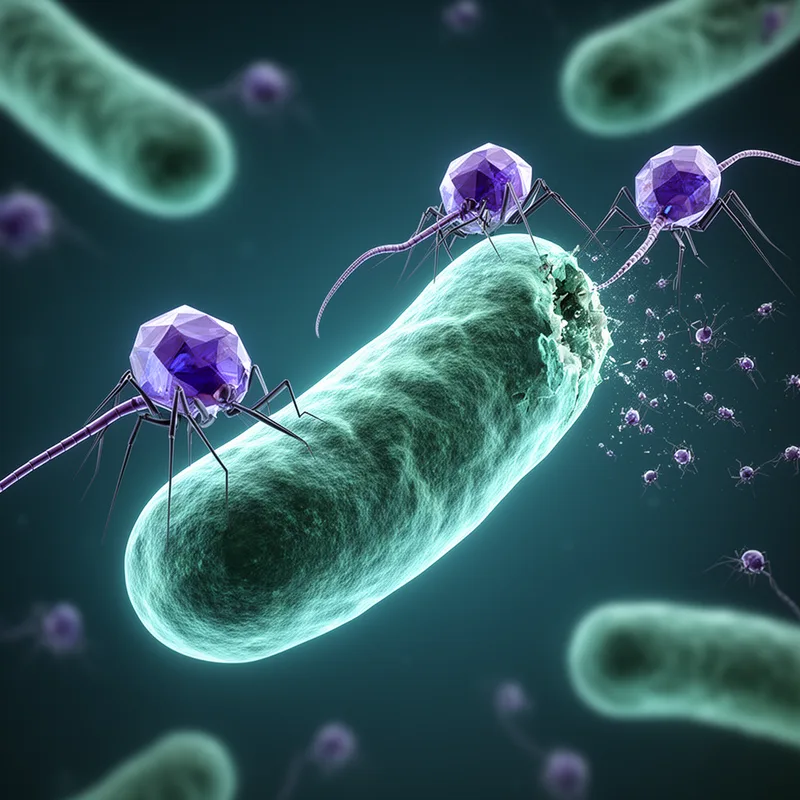
So phages are a type of viruses that only infect bacteria.
-
Bacteria at the perimeter may then encounter fewer phages and could escape infection.
Academic text (2003) -
The present work focused on a mixed phage assemblage that appeared more resistant to UV inactivation under test conditions.
Academic text (2003) -
Even with escapes, spraying of phages on spores substantially reduced bacterial growth.
Academic text (2003) -
The presence of multiple phage strains indicated the potential for selecting effective phages for different bacterial strains in diverse environments.
Academic text (2003)
Synonyms
 1
8.4
1
8.4
A virus that infects bacteria and kills them
Surface Forms
Etymology
The word phage comes from the Greek verb phagein, meaning 'to eat'. Think of a phage as a tiny 'eater' of bacteria, which is why some viruses are called bacteriophages ('bacteria-eaters') because they enter bacteria and destroy them.