
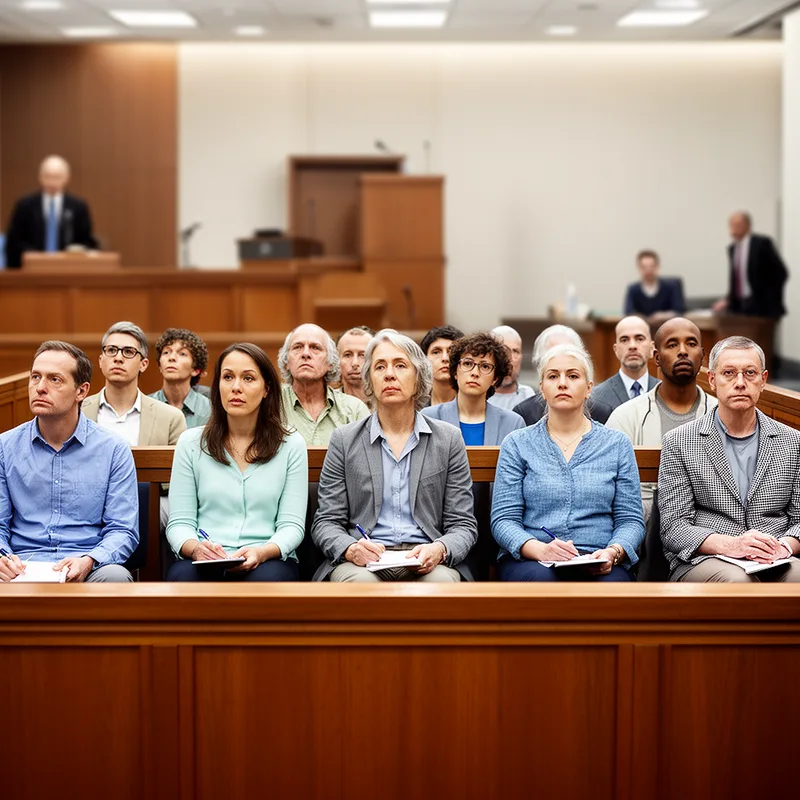
petit jury


 1
7.7
1
7.7
- noun
- /ˈpɛtɪ ˈdʒʊəri/
- Formal
- The petit jury listened carefully to the evidence presented during the trial.
Examples
-
Our founders believed that the citizens' grand and petit juries were essential to liberty for one historically proven reason.
Blog text (25) -
That same year, a federal district court judge delivered another setback to supporters of women jurors by ruling that as long as Georgia law excluded women from state court juries, it would be illegal for women to sit on federal grand or petit juries empaneled in the state.
Academic text (2007) -
After deliberating for several hours, the petit jury reached a verdict of not guilty.
-
During the trial, the judge explained the role of the petit jury in deciding the facts of the case.
Synonyms
 ∞
2.5
∞
2.5
A group of people sworn to listen to evidence in a court and give a verdict
 1
7.7
1
7.7
A group of people chosen for their special knowledge to decide a legal case

A group of twelve people who decide the facts and verdict in a criminal or civil trial
Antonyms

- Formal
259
6.2
A group of citizens who decide if there is enough evidence to charge someone with a crime
Surface Forms
Morphology
A learner who knows 'petit' as 'small' and 'jury' as a body that decides verdicts would likely interpret this as a 'small jury', so there is a clear compositional link. However, the term is a conventional legal label (the trial jury, typically twelve jurors) and the precise legal sense and customary number are not predictable from the parts alone, making the expression only partly transparent to a B1 learner.
Etymology
The noun petit jury comes from French where petit means 'small', so the phrase literally names a 'small' jury. It refers to the smaller group of about twelve people in court who hear the case and decide 'guilty' or 'not guilty', so that's why it now means the jury that gives the verdict.