
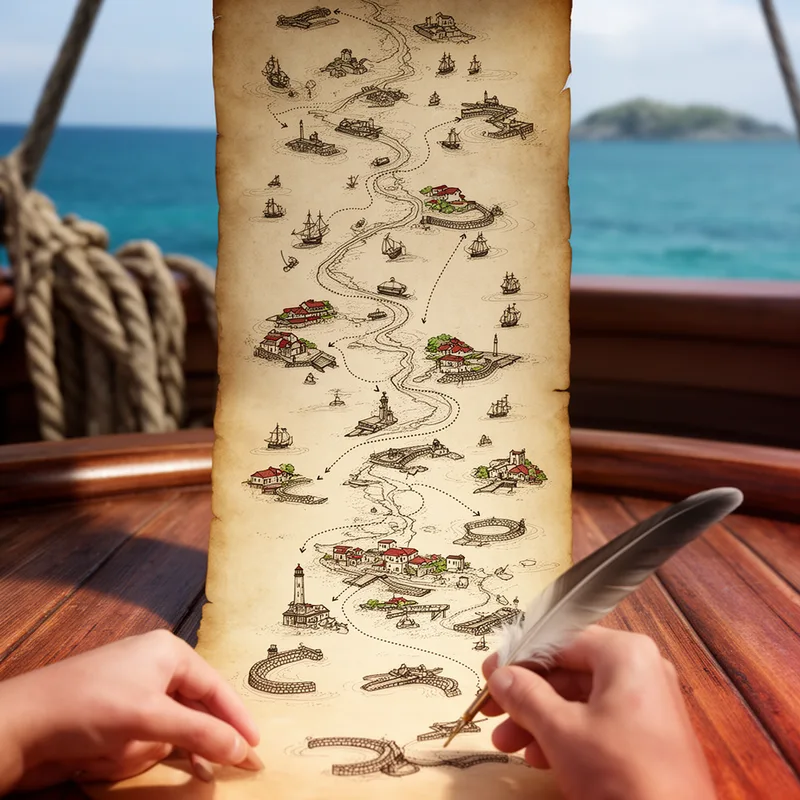
periplus
- noun
- /ˈpɛrəˌplʌs/
- Specialized
- For the distant east, he used information taken from another Periplus written in the second century by a Greek merchant named Alexandras.
Examples
-
A Roman merchant guidebook, the Periplus of the Erythraean Sea, written in AD 50, describes how the discovery was made:
Academic text (2010) -
The Periplus explained that somewhere beyond Rhapta, the coast of the African continent curved west to where the Indian Ocean meets the Atlantic.
Academic text (2010) -
During the time of the Periplus, Roman trade with India was restricted to the western coast of the subcontinent.
Academic text (2010) -
He structured his work spatially, following the traditional periplus or coastal voyage pattern.
Academic text (2004) -
As the Periplus was being written, Roman vessels were making ocean crossings from southern Arabia and the Horn of Africa directly to the Indus territories and the Tamil lands.
Academic text (2010) -
The Periplus records that whole stretches of the coast were inhabited by 'vicious' peoples who 'plunder any who stray from their course' and 'enslave anyone whom they rescue from shipwreck.'
Academic text (2010) -
The Periplus warns about the treacherous coastline of the Gujarat region, and sizeable sections of a Roman hull have been preserved in the seabed sediments of these waters.
Academic text (2010) -
At first, Roman ships generally traveled no further than a Somali market called Opone, but the Periplus describes how Arabian dhows sailed south along the African coast to reach a remote trading settlement called Rhapta, close to the edge of Zanzibar.
Academic text (2010) -
The ancient text known as the periplus outlines various ports and coastal landmarks encountered during sea voyages.
-
Scholars study the periplus for insights into ancient maritime trade routes and geography.
Synonyms

 12
3.3
12
3.3

A book where people write regular records of journeys, events, or activities

A book or chart with maps and sailing directions used by sailors in the past
Surface Forms
Morphology
periplus = peri + plous
The word is built from Greek combining forms ('peri-' + 'plous') that are not productive or familiar to average learners, so the meaning cannot be reliably derived from the parts.
Etymology
The word periplus comes from Greek parts peri- 'around' and -plous 'voyage'. In ancient times a periplus was a written record that listed ports and safe places to stop along a coast, which is why today it means a guide or account of a sea journey.