

periodontal
 3
7.6
3
7.6

- adjective
- /ˌpɪəriˈɒndəl/
- Specialized
- Patients with periodontal disease often experience gum inflammation and discomfort when eating.
- periodontal treatment
- periodontal disease
- periodontal membrane
Loading YouTube…
Watch on YouTubeBetween your tooth and your jawbone, there is a specialized piece of tissue called the periodontal ligament, or PDL for short.
- Between your tooth and your jawbone, there is a specialized piece of tissue called the periodontal ligament, or PDL for short.
- Other studies that support that decay and periodontal disease are caused by Dyspio comes from diet and dry mouth.
Examples
-
Some unusual and often severe periodontal infections are seen in individuals with HIV infection.
Academic text (2000) -
Several studies have examined the effect of periodontal treatment on preterm birth and low birth weight outcomes.
Academic text (2011) -
There are symptoms you can look for at home to identify possible periodontal disease.
Blog text (7) -
Therefore, the oral and periodontal status of the involved women is largely unknown.
Academic text (2011) -
The teeth show no signs of periodontal disease or tooth decay.
Academic text (2002) -
Conversely, several studies have failed to detect an association between periodontal disease and adverse birth outcomes.
Academic text (2011) -
In their study, periodontal treatment did not reduce the incidence of preterm delivery.
Academic text (2011) -
Dental caries and periodontal diseases are increasing in prevalence.
Academic text (2018) -
Mattar et al. described a case of periodontal disease that led to the diagnosis of septic emboli.
Academic text (2007) -
Between your tooth and your jawbone, there is a specialized piece of tissue called the periodontal ligament, or PDL for short.
Synonyms
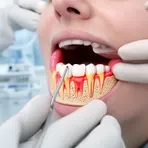
About the gums and other parts that support the teeth
Compounds

- Specialized
1
4.0
An infection of the gums and bone around the teeth that can cause tooth loss if not treated
Surface Forms
Morphology
periodontal = peri + odont + al
The word is built from classical combining forms meaning 'around' and 'tooth', but these elements are not transparent to an average learner.
Etymology
The word periodontal comes from the parts peri- 'around' and odont 'tooth', and you can see the same idea in English words like dental and dentist. So periodontal literally means 'around the tooth', which is why it describes the gums and the parts that support the teeth.