
perestroika
 20
9.9

- noun
- /ˌpɛrəˈstrɔɪkə/
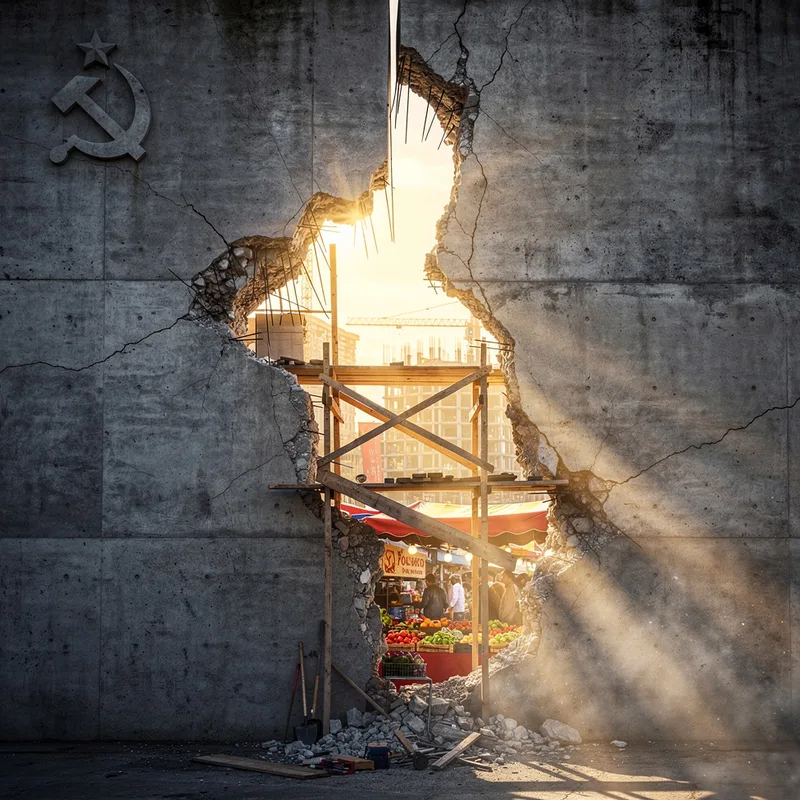
- In the 1980s, Mikhail Gorbachev introduced perestroika to revitalize the stagnant Soviet economy.
- perestroika and glasnost
- policy of perestroika
- years of perestroika
Examples
-
Since the first years of perestroika, democratization has also spread to this sphere.
Academic text (1991) -
Will Germany require evidence of a more peaceful perestroika as a condition for further assistance?
Academic text (1991) -
One may say that perestroika in our country has entered a critical stage.
Academic text (1991) -
Today, we have entered a stage when the fate of perestroika itself is at issue.
Academic text (1991) -
Even in the course of perestroika, politics continues to dominate the economy.
Academic text (1991) -
The starting conditions of perestroika were far better than present-day conditions.
Academic text (1991) -
Over all of this looms the shadow cast by the failure of Soviet perestroika.
Academic text (1991) -
Later the whole Soviet Empire collapsed, mostly owing to the policy of glasnost and perestroika implemented by M. Gorbachev.
Academic text (2017) -
Scarcely ten years ago, who would have anticipated perestroika and the apparently irresistible decline of communism everywhere?
Academic text (1991) -
Glasnost has been the principal domestic manifestation of perestroika, yet even glasnost, in many ways, is measured out in doses.
Academic text (1991)
Surface Forms
Etymology
Perestroika comes from Russian and means 'rebuilding'; it is built from the Russian parts pere- 're-' and stroit' 'to build'. So the name fit the Soviet policy of the 1980s because it was about 'rebuilding' the economy and the government.