
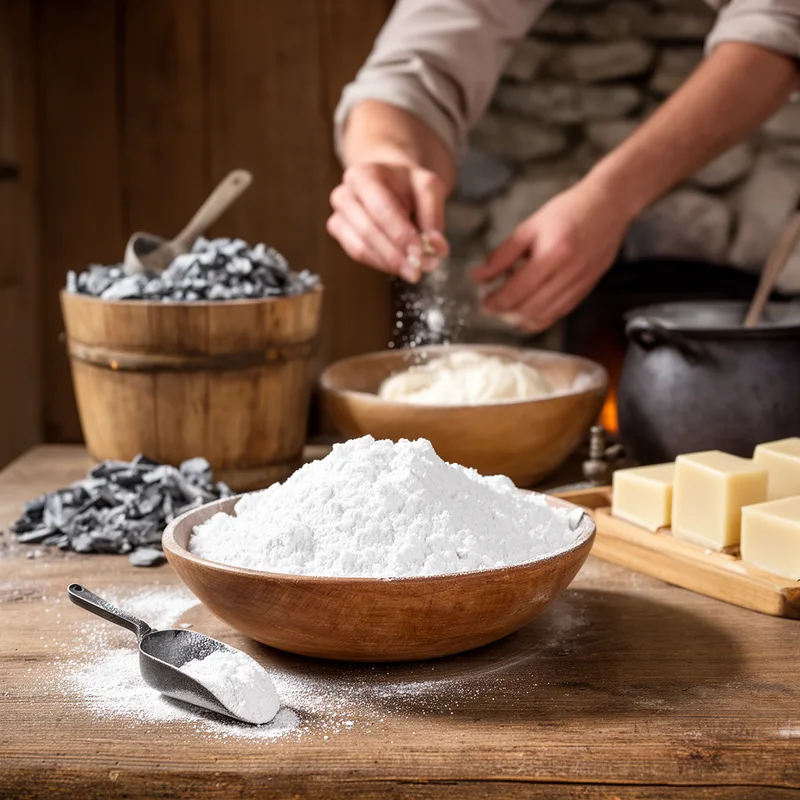
pearl ash
- noun
- /pɜrl æʃ/
- Archaic
- Early bakers commonly used pearl ash as a leavening agent before modern baking powder was developed.
Examples
-
The production of pearl ash involves extracting soluble salts from the ashes of burned wood.
-
In the 18th century, pearl ash was an important export commodity for American colonists.
-
The recipe called for pearl ash as a leavening agent.
-
Many old baking recipes include pearl ash for rising.
-
Early bakers commonly used pearl ash as a leavening agent before modern baking powder was developed.
-
In the 18th century, pearl ash was an important export commodity for American colonists.
-
Many old baking recipes include pearl ash for rising.
Synonyms

A white powder that dissolves in water and is used to make glass, soap, and cleaners
Surface Forms
Morphology
pearl + ash
The literal meanings of 'pearl' (a gem produced by mollusks) and 'ash' (powdery residue after burning) do not lead to the chemical sense 'impure potassium carbonate' used as a leavening/soap-making agent. This is a specialized, historical chemical name whose meaning is lexicalized and not compositionally predictable, so a B1 learner who knows the parts would not reliably infer the MWE’s meaning.
Etymology
The noun pearl ash comes from old ways of making a white salt from burned wood: when people washed and boiled the ash, it left small white lumps like pearls. These 'pearls' were actually a not-pure kind of salt used to make soap and 'help bread rise', so the name pearl ash came to mean that material used in baking and soap-making.

