
parton


 1
9.9
- noun
- /ˈpɑːrtən/
- Specialized
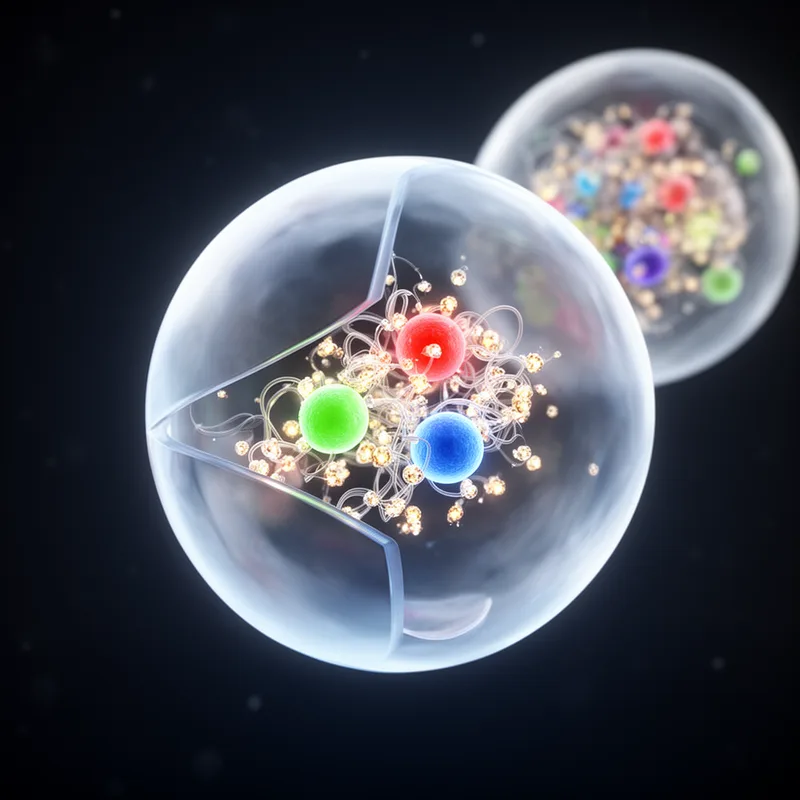
- In high-energy physics, a parton can refer to either a quark or a gluon that constitutes a proton or neutron.
- scattered partons
- parton collision
- parton substructure in hadrons
Loading YouTube…
Watch on YouTubeHe said just think of it as a swarm of partons moving real fast.
- He said just think of it as a swarm of partons moving real fast.
Examples
-
The energy is high enough to produce the direct high-energy scattering of individual quarks and gluons (the so-called partons) in the colliding nuclei.
Academic text (2003) -
The observation of hard-scattering processes in p-p collisions was one of the early, compelling arguments for the existence of a parton substructure in hadrons.
Academic text (2003) -
At RHIC, the scattered parton is embedded in a large volume of newly formed hot, dense matter.
Academic text (2003) -
In effect, such measurements probe the medium with beams of energetic partons.
Academic text (2003) -
The direction of the jet emerging from a hard-scattering collision is presumed to be the direction of the initially scattered parton.
Academic text (2003) -
Scientists study the interactions of partons to understand the strong force that holds atomic nuclei together.
-
During the experiment, researchers measured the behavior of the partons in the colliding particles.
Surface Forms
Morphology
Etymology
Parton comes from the simple word part ('a piece') plus the particle ending -on, like in electron and proton. So a parton is literally a 'small part' inside a proton or neutron, which helps you remember it means the tiny particles such as quarks and gluons that make up those bigger particles.