

parietal gyrus
- noun
- /pəˈraɪ.ɪ.təl ˈɡaɪ.rəs/
- Specialized
- Damage to the parietal gyrus can lead to difficulties in sensory processing and coordination.
Examples
-
Research shows that the parietal gyrus plays a significant role in spatial perception and movement planning.
-
Scientists studied the activity in the right parietal gyrus during mathematical problem-solving tasks.
-
The parietal gyrus plays a crucial role in sensory perception.
-
Researchers studied the parietal gyri in relation to spatial awareness.
-
Damage to the parietal gyrus can lead to difficulties in sensory processing and coordination.
-
Scientists studied the activity in the right parietal gyrus during mathematical problem-solving tasks.
-
Research shows that the parietal gyrus plays a significant role in spatial perception and movement planning.
Synonyms

 2
9.9
2
9.9

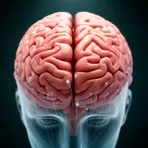
A raised fold on the brain surface between two grooves
 1
8.6
1
8.6
A fold on the brain surface that increases its outer area
Surface Forms
Morphology
The meaning is directly compositional: 'gyrus' denotes a brain fold and 'parietal' specifies its location in the parietal lobe, so a learner who knows both constituents can derive the phrase refers to a ridge on the parietal area of the brain. This adjective+noun anatomical naming pattern is regular and cross-linguistically common, making the expression predictable rather than idiomatic.
Etymology
Parietal gyrus comes from old words that paint a simple picture: parietal meant 'wall' and gyrus meant 'ring' or 'ridge'. So the name literally describes a ridged 'wall' on the side of the brain and is used for the raised fold in the parietal lobe.