

parhelic circle
- noun
- /ˈpɑːrˌhɛlɪk ˈsɜːrkl/
- Specialized
- The phenomenon known as the parhelic circle forms when sunlight passes through plate-shaped ice crystals.
Examples
-
Photographers often wait years to catch a clear parhelic circle above the snowy landscape.
-
A parhelic circle was visible for hours, stretching across the sky in the cold morning light.
-
Look at that faint parhelic circle over there!
-
I saw a parhelic circle in the sky today!
-
On a clear day, we witnessed a stunning parhelic circle that glowed faintly along the horizon as the sun shone above.
-
While hiking in the mountains, we were surprised to see a parhelic circle appearing as a bright band parallel to the sun.
-
The meteorologist explained how a parhelic circle can form when sunlight interacts with ice crystals in the atmosphere.
Synonyms
 28
5.6
28
5.6

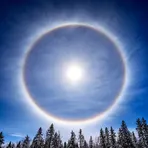
A circle of light around the sun or moon when ice in the air bends light
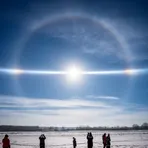
A bright ring across the sky at the same height as the sun formed when sunlight passes through ice crystals

A bright circle of light around the sun caused by ice crystals in the sky
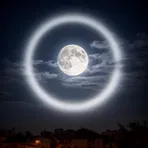
A ring of light around the sun or moon seen in the sky
Surface Forms
Morphology
The phrase is compositionally an adjective + noun: 'parhelic' denotes a halo-like/related-to-parhelia quality and 'circle' denotes a circular luminous feature, so a learner who knows both constituents would likely infer it refers to a halo-like circle. However, 'parhelic' is a rare, technical term and the precise meteorological details (height parallel to the horizon, solar geometry, ice-crystal optics) are not predictable from the parts, making the expression only partially transparent.
Etymology
Parhelic circle comes from Greek parts para meaning 'beside' and helios meaning 'sun'. It describes a pale ring that appears at the same height as the sun when sunlight hits flat ice crystals in the air, so the name helps you remember it is a circle 'beside the sun'.