
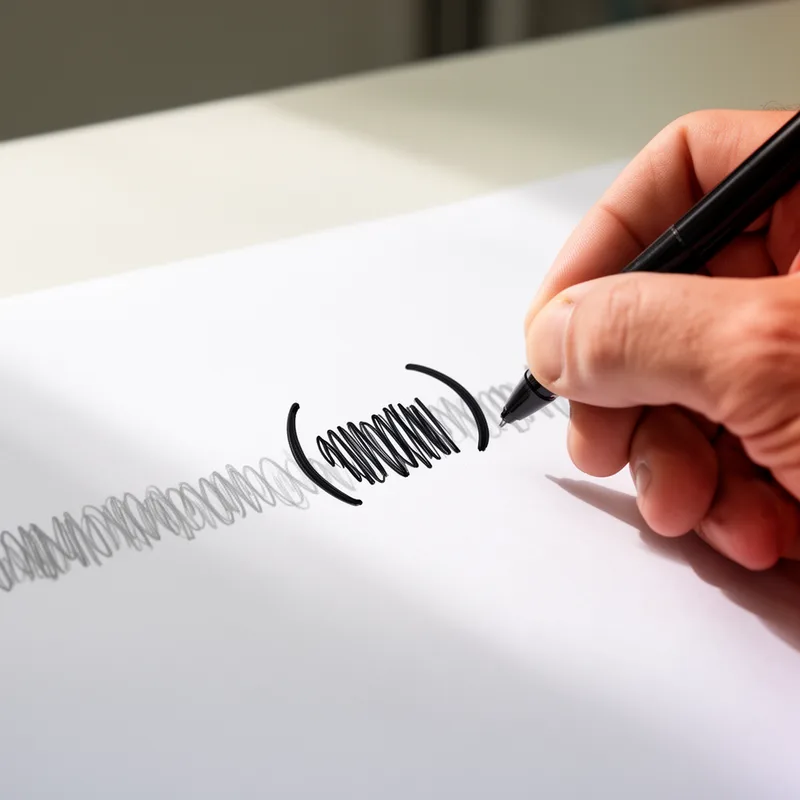
parenthetical


 1
7.5
1
7.5
- noun
- /ˌpɛrənˈθɛtɪkəl/
- If you disagreed with that, you could substitute anything that you consider less harmful (as the parenthetical was supposed to indicate), if it isn't so much less that it's practically harmless, and it wouldn't make a difference to the argument.
Loading YouTube…
Watch on YouTubeSo parentheticals should be used to make a line clear.
- So parentheticals should be used to make a line clear.
- So what I do is I break the blocks up using like parentheticals or using short action lines.
- You need to be able to state what your goal is in a single sentence with no commas, parentheticals, run ONS.
- And I said, OK, tell me your objection in a single sentence with no commas, no run ONS, no parentheticals.
Examples
-
You can add a parenthetical in your writing to explain your thoughts more clearly.
-
So parentheticals should be used to make a line clear.
-
So what I do is I break the blocks up using like parentheticals or using short action lines.
-
In his essay, he included a parenthetical remark that clarified his main point.
-
The author used a parenthetical to provide additional context without disrupting the flow of the text.
Synonyms
 1
5.3
1
5.3
A short remark added in speech or writing to give extra information

Words or a short phrase added inside a sentence to give extra information without changing its meaning
Compounds
Words or a short phrase added inside a sentence to give extra information without changing its meaning
How Essential
43
3.1
 62
3.3
1
7.5
62
3.3
1
7.5
- Literature
7
5.5
- Informal
17
6.1
Surface Forms
Morphology
parenthetical = parenthesis (transparent) = parenthesis + al
The meaning is a direct, rule-based extension of 'parenthesis' with '-al', so the connection is straightforward.
Etymology
Parenthetical comes from Greek parts para- 'beside' and -thesis 'placing', so a parenthetical (a short phrase in parentheses) is something 'placed beside' the main sentence to give extra information.