
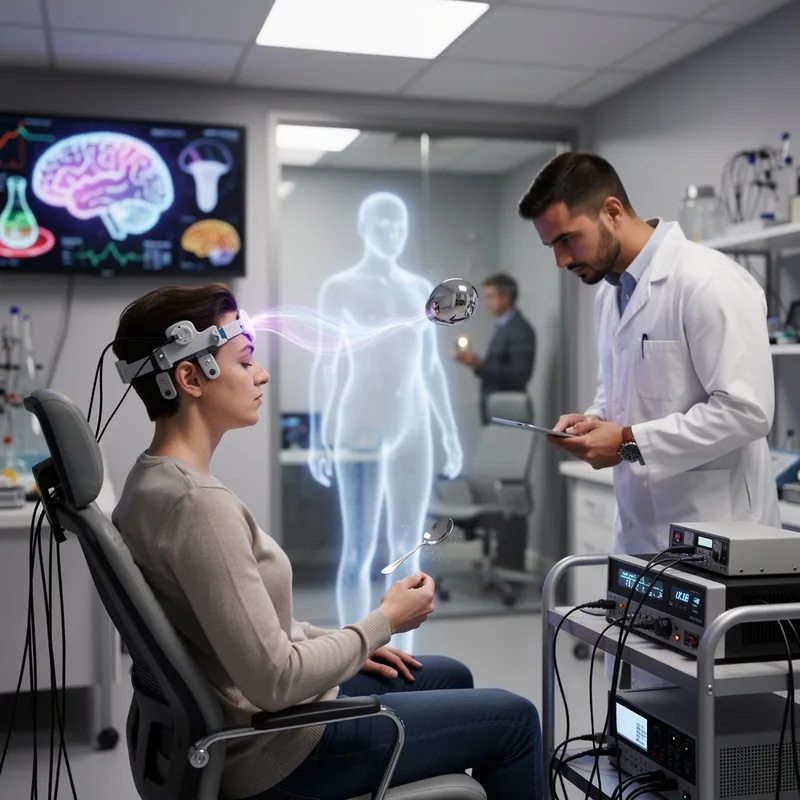
parapsychological
 1
9.9
1
9.9

- adjective
- /ˌpɛrəˌsaɪkəˈlɒdʒɪkəl/
- Specialized
- Many scientists remain skeptical of parapsychological claims due to lack of empirical evidence.
- parapsychological research
Examples
-
The study of telepathy and clairvoyance falls under parapsychological research.
-
She attended a conference focused on parapsychological phenomena like psychokinesis.
-
When people tell me about possible parapsychological claims, life after death, things like that, these are possible.
-
Parapsychological and spiritual data agree.
Academic text (1995) -
If parapsychological effects are real, it seems natural to assume that prayer is an effective way of influencing the environment.
Academic text (1995) -
The parapsychological model of God is strictly empirical; it is not a theology or a mythology.
Academic text (1995) -
Significant evidence from parapsychological research supports the notion that thoughts, dreams, and visions can be communicated to others at a distance or nonlocally.
Academic text (1994) -
The question is why does every parapsychological phenomenon vanish when there's a qualified skeptic in the room?
-
One of the strongest empirical findings of parapsychological research is that people are more likely to be receptive to the nonlocal universe if they attend to their internal states.
Academic text (1995) -
Many synchronistic events can also be described by parapsychological terms such as telepathy, the communication from one mind to another, or precognition, in which a person has a dream or premonition of something that will happen in the future.
Academic text (1993)
Synonyms
 207
8.4
207
8.4
About events or abilities that cannot be explained by science, like telepathy
 115
6.7
115
6.7
Not explained by nature or science and believed to come from other forces
 60
7.0
60
7.0
Science cannot explain things like ghosts or people moving objects with their mind
 1
9.9
1
9.9
About mental powers people say are supernatural, like telepathy and clairvoyance
How Paranormal

Surface Forms
Morphology
parapsychological = parapsychology (semi-transparent) = para + psych + ology + ical
The word is a regular adjective formation from the technical noun 'parapsychology', but the base noun is specialized and not transparent to many learners.
Etymology
Parapsychological starts with para- meaning 'beyond' and psycho- meaning 'mind', like in psychology and psychic. The -logical part means 'study', so the word means the 'study of things beyond the normal mind', which is why it is used for telepathy, ghosts, and similar unexplained experiences.