
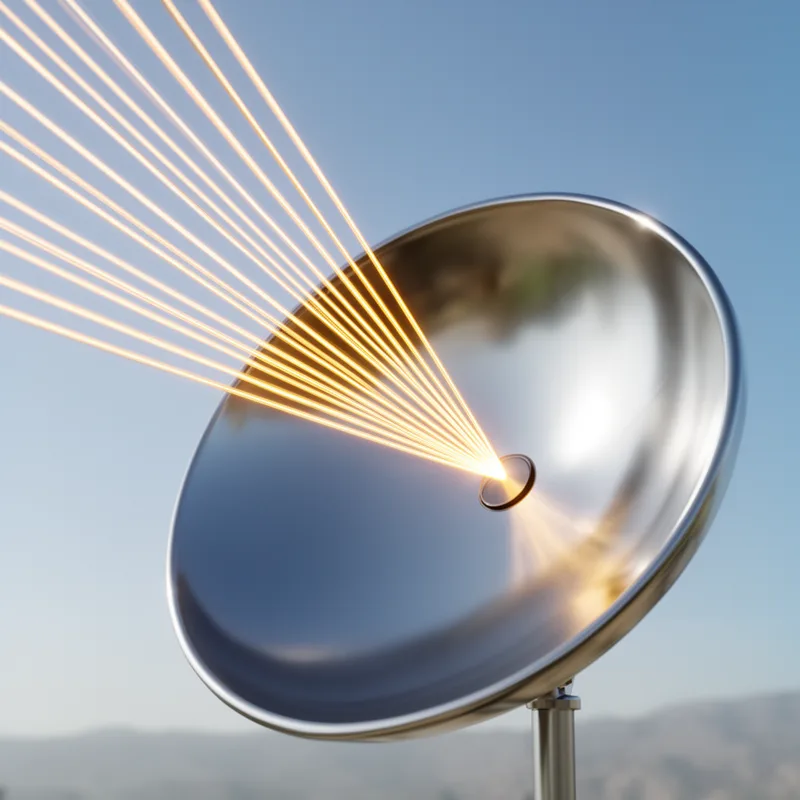
parabolic mirror
 1
6.6
1
6.6

- noun
- /ˌpɛrəˈbɑlɪk ˈmɪrər/
- Specialized
- The telescope uses a large parabolic mirror to focus distant light onto a sensor.
Loading YouTube…
Watch on YouTubeNow how a parabolic mirror works is you have light sound coming in and the parabolic shape acts to focus it onto a single point.
- Now how a parabolic mirror works is you have light sound coming in and the parabolic shape acts to focus it onto a single point.
Examples
-
A parabolic mirror can concentrate sunlight to generate electricity efficiently.
-
Now how a parabolic mirror works is you have light sound coming in and the parabolic shape acts to focus it onto a single point.
-
Nor one and two are both through based systems that use parabolic mirrors with the tube located in the mirrors focal point.
-
In order to minimize chirp, the white light beam was collimated by an off-axis parabolic mirror and split by a broadband 50/50 beam splitter to a reference and probe beam.
Academic text (2018) -
Engineers designed a solar power plant with thousands of parabolic mirrors to capture sunlight.
Synonyms
A curved dish that sends out a parallel beam or focuses parallel light and radio waves
A curved surface shaped like a bowl that focuses light or sound into a beam
Antonyms

How Focused

Surface Forms
Morphology
The meaning is directly and compositionally derived from 'parabolic' (having the shape/curvature of a parabola) + 'mirror' (a reflective surface): a mirror with a parabolic shape. This adjectival+noun composition is predictable and cross-linguistically transparent, so a B1 learner who knows both constituents can infer it focuses parallel rays toward a point.
Etymology
Parabolic mirror comes from the mirror's curved shape: parabolic means a smooth, bowl-like curve and mirror is the shiny surface that has that shape. So, this mirror makes parallel rays of light meet at one point and therefore 'focuses' light to a single spot.