
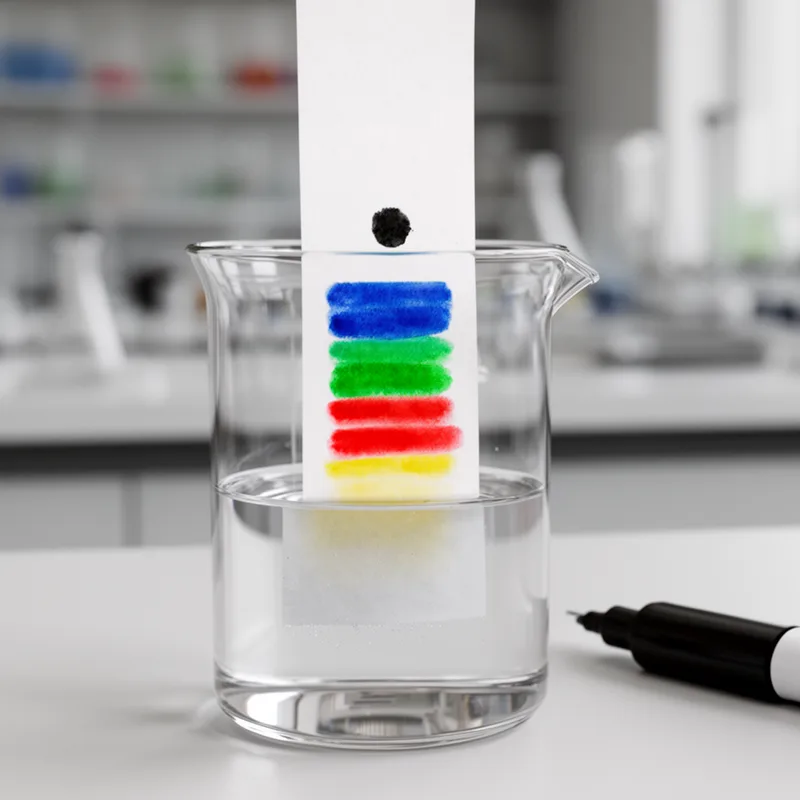
paper chromatography
- noun
- /ˈpeɪpər ˌkrəʊməˈtɒɡrəfi/
- Specialized
- You can see this just by looking at the trees, but another way to examine the change in pigment concentrations is to perform paper chromatography on the leaves.
Examples
-
Ekwealor and Obeta (2005) employed paper chromatography for the detection of lysine in fermented broth.
Academic text (2015) -
In the laboratory, scientists often use paper chromatography to separate different pigments in a sample.
-
A paper chromatography test.
-
The chemistry class demonstrated paper chromatography to show how food coloring can be separated into its components.
-
To analyze the ink composition, the students decided to try paper chromatography during their experiment.
How Effective
- Specialized

- Specialized
 3
8.6
3
8.6

- Specialized
Surface Forms
Morphology
The meaning 'a method of chromatography using paper as the medium' is directly and compositionally derivable from 'paper' (the support material) + 'chromatography' (a separation technique). This is a literal, productive noun-noun compound and is cross-linguistically regular, so a B1 learner who knows both constituents would readily understand it.
Etymology
Paper chromatography comes from a simple lab trick: a strip of paper is touched with a liquid that moves up and carries different colors at different speeds, and chromatography means 'separating by movement'. So, paper chromatography is a 'method to separate parts of a mixture' by letting them travel along paper.