
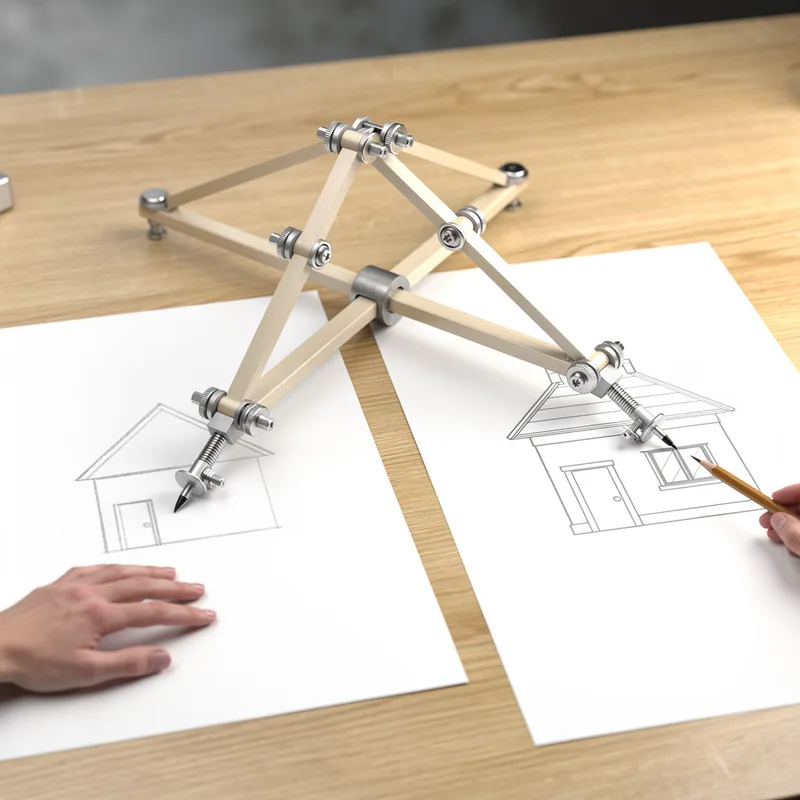
pantograph


 1
9.9
- noun
- /ˈpæn.təˌgræf/
- Specialized
- In 1906, he described a "delineating machine," which used a pantograph that traced a large drawing of a typeface and produced a steel punch at a much-reduced scale.
Examples
-
With a pantograph, you can easily scale up your blueprints for the construction project.
-
The artist used a pantograph to create a larger version of his original sketch.
-
I want to show Santa some improvements on the pantograph.
-
The pantograph causes oscillations in the catenary.
Blog text (34) -
The vehicle collects electric power through pantographs on the locomotive roofs.
Academic text (1993) -
Physionotrace portraits were small-scale engravings produced using a silhouette apparatus and a pantograph.
Academic text (2011) -
A pantograph allowed the teacher to enlarge the map so all students could see it clearly.
Surface Forms
Morphology
pantograph = panto + graph
This is a learned classical formation from panto- and graph, but the meaning 'a device for copying drawings at a different scale' is not readily inferable for an average learner.
Etymology
The word pantograph comes from the Greek parts pan- meaning 'all' and -graph meaning 'write' or 'draw', the same parts you see in panorama and autograph. So a pantograph is a tool that 'writes' or 'draws' the same picture at different sizes, which is why it copies or makes a drawing larger or smaller.