
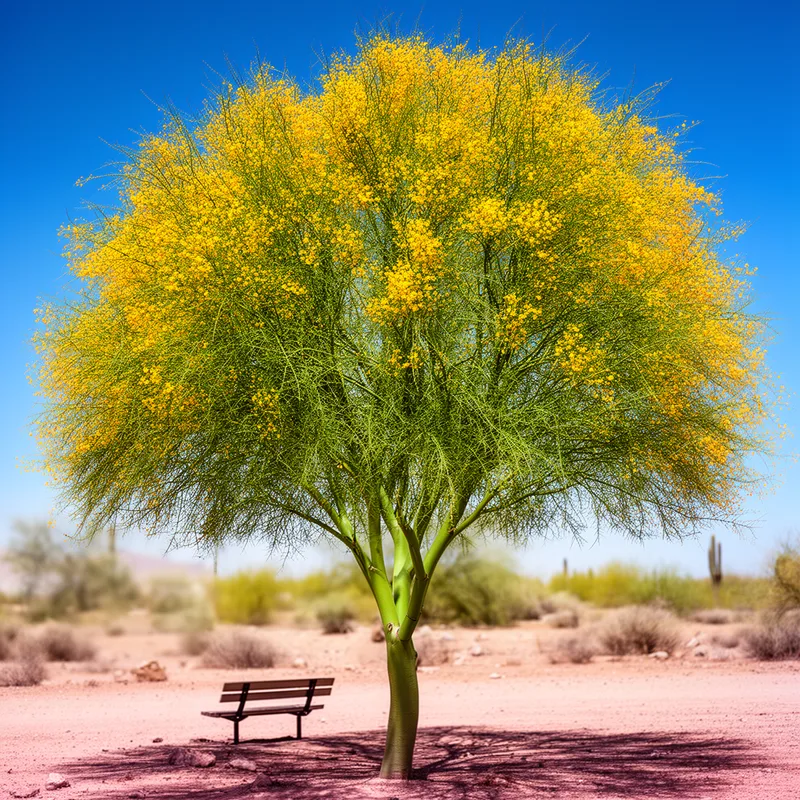
palo verde


 1
8.6
1
8.6
- noun
- /ˈpɑːloʊ ˈvɜrdeɪ/
- US
- During our hike, we noticed several palo verde trees standing tall against the arid landscape.
- palo verde tree
- palo verde, mesquite
- palo verde and cactus
Examples
-
The owl is in a thicket of palo verde on the far hillside; I can make out the direction, but the bird is hidden.
Fiction book (2002) -
Cottonwoods, willows, and mesquites have recolonized the secondary flood plains, while palo verde trees occupy the more distant hillsides.
Academic text (2001) -
The Palo Verde tree also gives high-protein beans.
Blog text (1) -
A hot breeze was stirring the palo verde in the front yard.
Fiction book (1992) -
"To his left, trees skip past acacia, palo verde, the eternal eucalyptus."
Fiction book (1993) -
"Cottonwoods and willows are a struggle, but the mesquites and palo verdes are doing fine on their own."
Academic text (2001) -
They stopped under the blue-green branches of a palo verde tree and looked off into the vast stillness.
Fiction book (1999) -
Sporadic birds and mammals, along with snakes and lizards, survive on next to nothing in the saguaros, mesquite, and palo verde.
Fiction book (2002) -
Milton raced after Steven, aiming at the zigzagging blue shirt, the crack of the gun, a palo verde trunk catching the rifle barrel and spinning Milton to his knees.
Fiction book (1990) -
In our garden, the beautiful palo verde blooms with bright yellow flowers every spring.
Synonyms
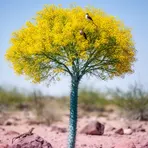
A spiny tree of the southwestern United States with bright yellow flowers and blue-green bark

A spiny tree with many branches, blue-green bark, and bright yellow flowers that grows in desert areas
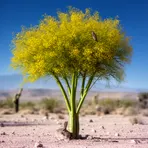
A thorny small tree with smooth green bark and yellow flowers in dry areas
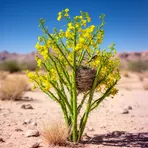
A small spiny tree or shrub with green bark and yellow flowers that grows in dry places like deserts
Surface Forms
Morphology
palo + verde
This is a Spanish loan name literally composed of palo (wood/stick/tree) + verde (green); the denotation of a green/green-barked tree is directly derivable from the constituents. Plant names formed by color + noun are cross-linguistically common, so a learner who knows the two constituent meanings can infer the MWE's sense.
Etymology
Palo verde comes from the Spanish words palo ('stick' or 'tree') and verde ('green'), a simple picture of the tree's green trunk and branches. That's why palo verde means the desert tree with green bark and bright yellow flowers.