
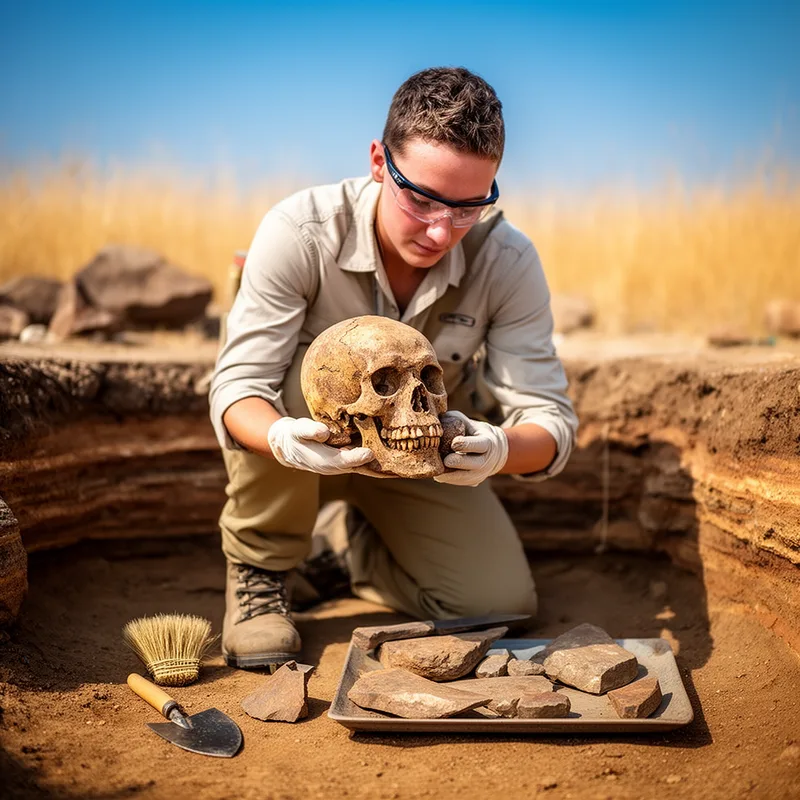
paleoanthropologist
 1
9.9
1
9.9

- noun
- /ˌpeɪli.oʊˌænθrəˈpɑlədʒɪst/
- Specialized
- "I'm convinced that if one were to raise a Neanderthal in a modern human family, he would function just like everybody else," says Trenton Holliday, a paleoanthropologist at Tulane University.
- paleoanthropologist at university
Examples
-
Arturo Gonzalez, a paleoanthropologist and cave diver who works for Mexico's National Institute of Anthropology and History (INAH), later recovered and studied Naharon Woman.
Academic text (2011) -
I was trained as a paleoanthropologist, studying human evolution from an integrative perspective.
Blog text (11) -
For the paleoanthropologist, the situation is somewhat more complex.
Blog text (26) -
"I see nothing in the foot that suggests bipedality," says paleoanthropologist William Jungers of Stony Brook University.
Academic text (2010) -
"There are humans today who are more different from each other in phenotype and physical characteristics," says John Hawks, a paleoanthropologist at the University of Wisconsin.
Academic text (2010) -
Ask any paleoanthropologist what got humankind started on its unique evolutionary trajectory, and the reflex answer will almost certainly be "the adoption of upright bipedalism."
Academic text (2003) -
In just such a pharmacy, in Hong Kong in 1935, the German paleoanthropologist Ralph von Koenigswald came across a large fossil primate molar that did not belong to any known species.
Academic text (1991) -
In 1974, after having just completed his doctorate, paleoanthropologist Donald C. Johanson attained worldwide fame for the discovery of "Lucy," a fossil skeleton from the Afar region of Ethiopia.
Academic text (1994) -
As a paleoanthropologist, she dedicated her career to uncovering the mysteries of early human ancestors through fossil analysis.
-
At the conference, the paleoanthropologist presented her findings on the relationship between ancient humans and their environment.
Surface Forms
Morphology
paleoanthropologist = anthropologist (transparent) = paleo + anthropologist
The prefix 'paleo-' meaning 'ancient' is productively attached to the familiar base 'anthropologist', so the meaning 'a scientist who studies ancient humans' follows directly.
Etymology
Paleoanthropologist is made of three parts: paleo- ('old'), anthropo- ('human'), and -logist ('one who studies'), the same idea you see in anthropology or biologist. So a paleoanthropologist studies very early humans and their fossils.