

palatoplasty
- noun
- /ˌpælətəˈplæsti/
- Specialized
- A retrospective analysis involving patients with VPI post-primary palatoplasty, whose VPI was treated with double-opposing Z-plasty by a single surgeon, was performed.
- laser palatoplasty
- cautery palatoplasty
Examples
-
Furlow palatoplasty can both lengthen and thicken the palate and has a tendency to decrease airway space.
Academic text (2015) -
The short-term results of their series of 16 laser palatoplasty patients were similar to those of UPPP studies, but complications were minimal.
Academic text (1999) -
Double-opposing Z-plasty remains an effective tool in selected patients with VPI post-primary palatoplasty.
Academic text (2015) -
All patients met the following inclusion criteria: subjects had VPI; subjects previously underwent palatoplasty for a cleft of the secondary palate; and subjects were already followed in the craniofacial anomalies clinic.
Academic text (2015) -
The surgeon performed a palatoplasty to repair the patient's cleft palate, leading to improved speech outcomes.
-
After the palatoplasty, the child was able to eat and speak more normally, enhancing their quality of life.
-
Doctors recommend palatoplasty for children with cleft palates to help them develop proper speech patterns.
Synonyms
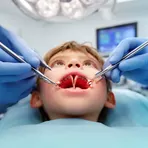
An operation that fixes a split in the roof of the mouth
How Invasive
- Specialized
 16
3.9


- Specialized
- Specialized
- Specialized
Surface Forms
Morphology
Etymology
Palatoplasty comes from palato-, from Latin palatum meaning 'palate', and -plasty, from a Greek word meaning 'to shape', like the everyday word plastic. So, palatoplasty literally means 'shaping the palate', which is why it is the surgery to repair or rebuild the palate.