
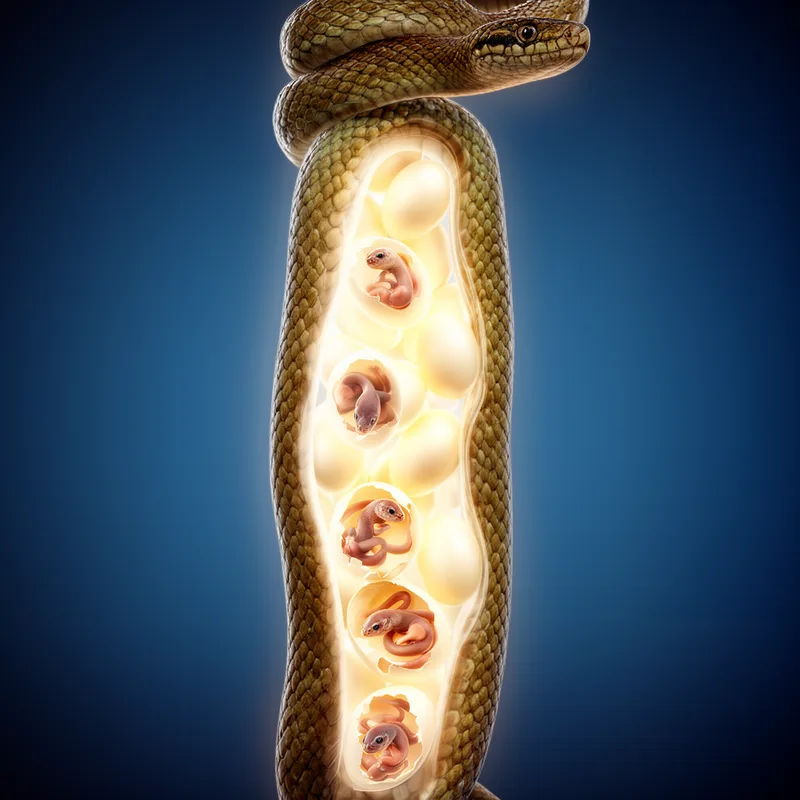
ovoviviparity
- noun
- /ˌoʊvoʊˌvaɪvɪˈpærɪti/
- Specialized
- In ovoviviparity, the eggs develop inside the female until they hatch, resulting in live young being born.
- ovoviviparity and viviparity
Examples
-
Ovoviviparity has been defined several ways (see Yaron 1985 for a discussion) but is usually described as a condition in which the female retains the yolk-laden egg in utero until it hatches internally, followed by birth.
Academic text (1993) -
Historically, three terms have been used to describe vertebrate reproductive modes: oviparity, ovoviviparity, and viviparity.
Academic text (1993) -
Increased maternal investment in progeny through viviparity or ovoviviparity is often assumed to result in decreased fecundity.
Academic text (1991) -
In fact, the concept of a gradual transition between ovoviviparity and viviparity was based on the belief that complete egg retention evolved first, followed later by the loss of the eggshell and the development of a placenta.
Academic text (1993) -
Comparison of rockfish fecundity with oviparous fish taxa may indicate if total fecundity is indeed lower in rockfishes as a result of their ovoviviparity.
Academic text (1991) -
Some species, such as certain sharks, exhibit ovoviviparity, where the embryos are nourished by the egg yolk instead of a placenta.
-
An example of ovoviviparity can be seen in guppies, which give birth to fully formed young after the eggs hatch inside the mother's body.
How Live-Bearing

Surface Forms
Morphology
ovoviviparity = viviparity (opaque) = ovo + viviparity
Although the parts correspond to 'ovo-' (egg) + 'viviparity' (live birth), these are technical combining forms unfamiliar to average learners, so the overall meaning is not readily inferable by a B1 learner.
Etymology
Ovoviviparity combines ovo- 'egg' and viviparity 'live birth'. The viv- part is the same root as in 'survive', meaning 'live', so the word describes eggs that develop inside the parent and hatch there, producing live young.

