
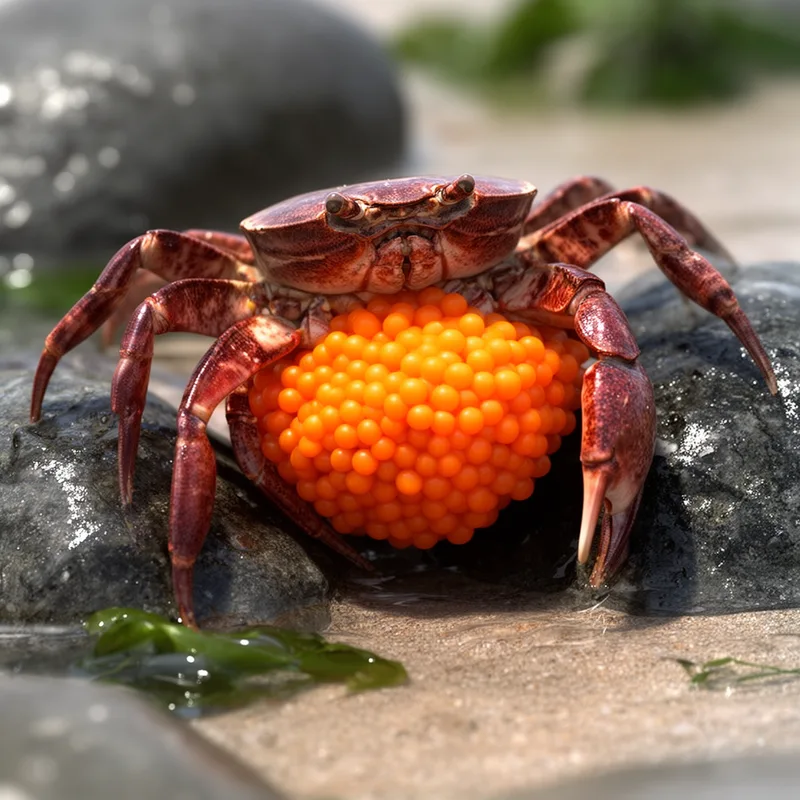
ovigerous
- adjective
- /ˈoʊvɪdʒərəs/
- Specialized
- The catches were sorted in the laboratory according to species and whether they were ovigerous, and measured for body weight and carapace length.
- ovigerous females
Examples
-
The Research Station aided their efforts by supplying ovigerous females at the New England Aquarium in Boston.
Academic text (1999) -
The scientists observed several ovigerous crabs during their underwater survey in the reef.
-
Only 11 (13.8%) of the 80 females were ovigerous.
Academic text (1992) -
Ovigerous females and individuals with damaged lateral spines were excluded.
Academic text (1998) -
From 1917, ovigerous females could be sold only to the state, which marked them with a hole punched into their uropod and then released them back into local waters as property of the state (Miller, 1995).
Academic text (1999) -
Female H. laevigatus appear to become ovigerous at -40 mm carapace length, and at 50 mm most of the females collected were ovigerous (Fig. 5b).
Academic text (1992) -
Female H. laevigatus appear to become ovigerous at -40 mm carapace length, and at 50 mm most of the females collected were ovigerous (Fig. 5b).
Academic text (1992) -
The same sex ratio was reported for this species in Hawaii by Dailey and Ralston (1986), who also recorded seasonal fluctuations in the proportion of ovigerous females.
Academic text (1992) -
However, recent evidence suggested that fishermen were now dipping ovigerous lobsters in a chlorine bleach solution that dissolved all of the residual cement so that no obvious external signs could be seen by the naked eye.
Academic text (1999) -
Aquarists noted that the ovigerous female shrimp displayed vibrant colors to attract mates.
Surface Forms
Morphology
ovigerous = oviger (semi-transparent) = ovi + ger + ous
This is a learned biological formation meaning 'egg-bearing'; the parts are semantically clear in technical terminology, but the classical elements are unlikely to be fully transparent to an average B1 learner.
Etymology
Ovigerous comes from the parts ovi- meaning 'egg', as in ovary, and -gerous meaning 'carrying' or 'bearing'. So, ovigerous means 'carrying eggs', which is why scientists use it for animals like crabs or insects that carry eggs.

