
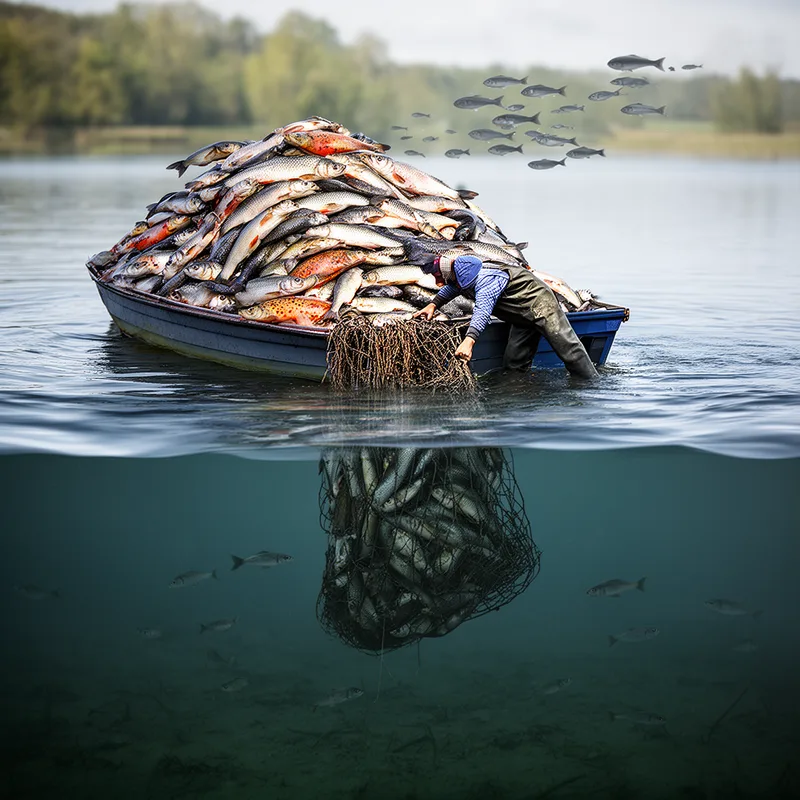
overharvest
- noun
- /ˌoʊvərˈhɑːrvɛst/
- Fishery regulations that do not consider neighbor effects risk large-scale overharvest of fish stocks (Carpenter and Brock 2004).
Examples
-
Wilcove and colleagues (1998) included only overharvest, to the exclusion of bycatch, persecution, and accidental mortality.
Academic text (2006) -
(Female moi are generally larger than the males, so moi are particularly vulnerable to overharvest, because taking a substantial portion of larger individuals severely reduces the reproductive capacity of the species.)
Academic text (2004) -
The problem of overharvest, it would seem, was solved.
Academic text (2018) -
Overharvest and disease often lead to a population crash.
Academic text (2011) -
The current decline in salmon can be attributed to the impact of hydroelectric dams, irrigation projects, overharvest, and overall habitat loss.
Academic text (2012) -
The most commonly harvested fish in the world today is anchoveta (Engraulis ringens), which has had a dynamic history of overharvest and fluctuating production.
Academic text (2009) -
Many biologists have assumed that Humboldt squid are expanding into niches left vacant by the overharvest of large predatory fish like tuna and marlin.
Academic text (2007) -
A modeling exercise by Gudmundsson and Wessells (2000) revealed that overharvest problems in open-access fisheries might not be solved by awarding a label to a fishery.
Academic text (2011) -
The overharvest of forests has led to significant environmental damage in many regions.
-
Continued overharvest has resulted in the depletion of certain fish species along the coast.
Synonyms

 16
3.8
16
3.8

Using something too often so it becomes harmful or less effective
 3
4.9
3
4.9
Using more food, goods, or natural resources than you need causes harm


 1
7.4
1
7.4
Using a natural resource so much that it becomes damaged or runs out
 1
7.5
1
7.5
Using something too much makes it less useful
How Sustainable

Surface Forms
Morphology
Etymology
The word overharvest comes from over- meaning 'too much' and harvest meaning 'to gather crops or animals for food'. So an overharvest is the act or amount of gathering too much and causing long-term harm to a resource.