
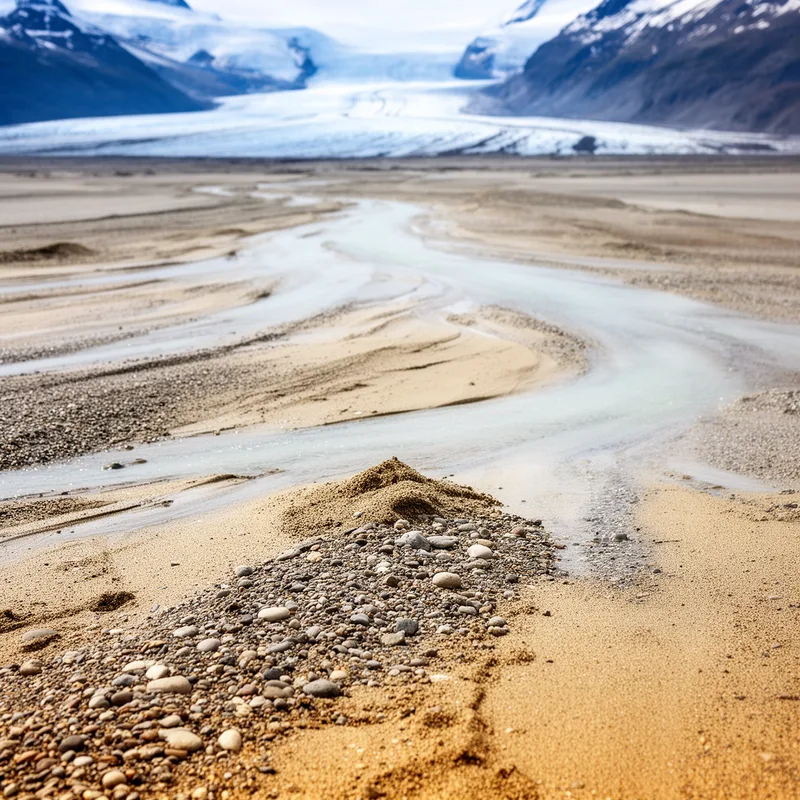
outwash


 1
8.4
1
8.4
- noun
- /ˈaʊtˌwɔʃ/
- UK
- At the edge of the glacier, you can see the outwash that was deposited by the rushing meltwater.
- glacial outwash
- outwash plain
Examples
-
So the outwash means that when wind hits a runner on the torso, it changes the direction of the wind, and it's going to go out to the sides.
-
The streams, lakes, and terrestrial surfaces studied were formed in unconsolidated glacial deposits that included till and outwash.
Academic text (2007) -
We were maximizing what we call the outwash around each runner.
-
The meadow soils are derived from glacial outwash materials of cinders, pumice, and ash, and are cold and wet.
Academic text (2000) -
The park sits on one of Europe's largest glaciers and is made up of three different geological areas: Skaftafell and Skeioarrsandur, a volcano and outwash plain.
Blog text (26) -
Similarly, close proximity to tidewater glaciers and turbid outwash streams severely limits community development in the intertidal ecosystem, regardless of substrate age.
Academic text (2007) -
When glaciers melt, they leave in outwash plains boulders, rocks, gravels, sand, and clays—sand ground to floury powder.
Academic text (1998) -
The outwash from the glacier formed a large, flat plain filled with sand and gravel.
-
Excavations in the outwash area revealed layers of sand and gravel from previous ice ages.
Surface Forms
Morphology
outwash = wash (semi-transparent) = out + wash
The components 'out' + 'wash' are clear, but the specialized glacial depositional meaning (sand and gravel deposited beyond a glacier) is domain-specific and not fully predictable for an average B1 learner. [Postprocessing: moved 'out' from base_words to prefix]
Etymology
Outwash comes from the simple parts out and wash, where wash means 'to move by water'. So an outwash is the sand and gravel that meltwater 'washes out' from a glacier and leaves beyond its edge.