

osteologist
- noun
- /ˌɑːstɪˈɒlədʒɪst/
- Specialized
- Marea turns again to that item in the paper about the 200,000-year-old woman in The Gambia: "the osteologists agree that she died of a broken leg, most likely due to a fall from carrying some heavy burden on her back.
Examples
-
The osteologist conducted a thorough examination of the ancient bones found at the dig site.
-
As an osteologist, she specializes in analyzing skeletal remains to understand human history.
-
Jill Bewsher Humphries, an English osteologist, examined Bruere's remains in November.
Academic text (2009) -
"It's about one of the most significant archaeological finds of the last decade: osteologists unearthed bones in The Gambia, which led geneticists to believe that the entire population of Earth descended from a single woman who lived in Africa 200,000 years ago."
Fiction book (1996) -
The university invited an osteologist to give a lecture on the evolution of human bones.
Synonyms

 4
7.6
4
7.6

A person who studies the inside parts of people and animals, like bones and organs
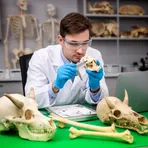
A person who studies bones to learn about people or animals
How Formal

Surface Forms
Morphology
Etymology
Osteologist starts with osteo-, a Greek root meaning 'bone', and ends with -logist, meaning 'one who studies'. So an osteologist is a 'bone scientist' — a specialist who studies bones.