
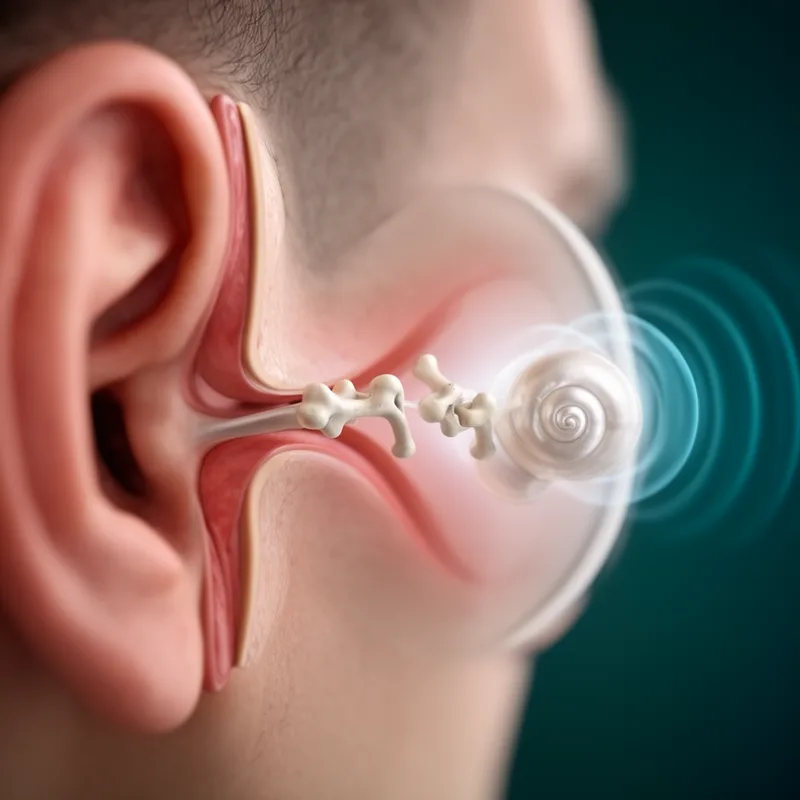
ossicle
- noun
- /ˈɑsɪkəl/
- Specialized
- Displacements in the ear, such as movements of the tympanic membrane or ossicles, are induced by changes in sound pressure.
- ear ossicles
- middle ear ossicles
- destruction of ossicles
Examples
-
Hearing loss can occur if one or more ossicles in the middle ear are damaged.
-
Neither the tympanic membrane nor the ossicles were damaged during these procedures.
Academic text (1998) -
Soft tissue extended into the area of the oval window, but the ossicles were intact.
Academic text (2009) -
The chain of ossicles represents a mechanical lever.
-
Severe trauma may also damage the ossicles, facial nerve, and inner ear structures.
Academic text (2006) -
The transducer is hermetically sealed and is designed to be attached to a middle ear ossicle.
Academic text (1998) -
The ossicles were intact, as was the VIIth cranial nerve (figure 1, C and D).
Academic text (2005) -
The Douek-MEDTM Middle Ear Device from USBiomaterials allows partial or total replacement of the middle ear ossicles with interposition material.
Academic text (1995) -
The granulomatous process often produces visible destruction of the ossicles, which can be seen through the tympanic membrane perforation.
Academic text (2002) -
With a finely focused laser beam, this bony fixation is removed with the ossicles still intact, and a freely mobile malleus is achieved.
Academic text (1995)
Synonyms

A very small bone in the middle ear that helps carry sound to the inner ear

One of the three tiny bones in the middle ear that help you hear
One of three small bones in the middle ear
Compounds
- Specialized
A very small bone in the middle ear that helps carry sound to the inner ear
Surface Forms
Morphology
Etymology
Ossicle comes from the Latin parts os meaning 'bone' and -icle meaning 'small', so it literally means 'small bone'. That's why ossicle names the tiny bones in the middle ear that help carry sound to the inner ear.

