
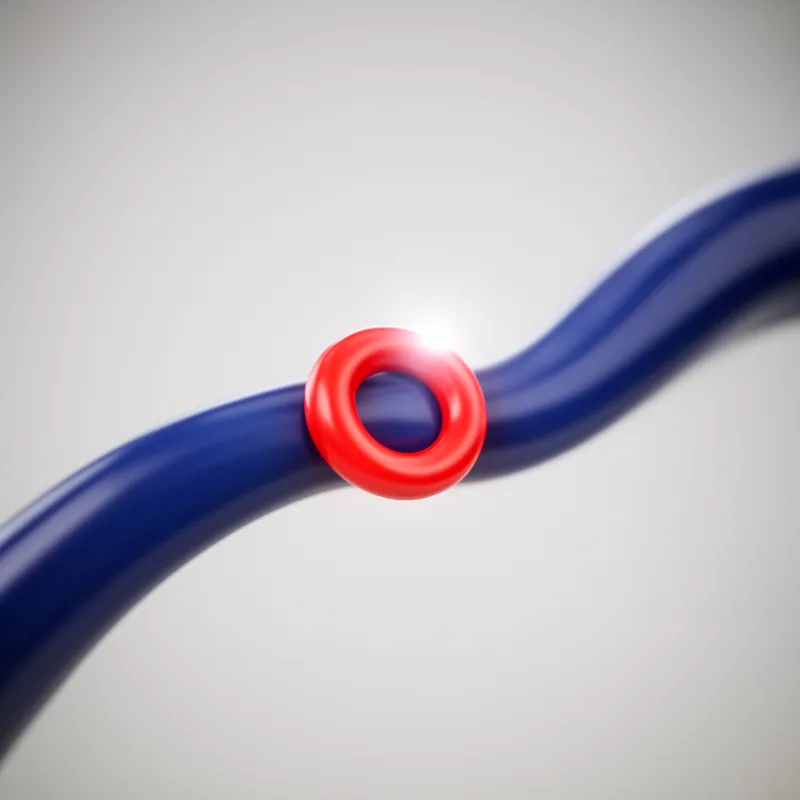
to osculate
- verb
- /ˈɒskjʊleɪt/
- Specialized
- The two curves osculate at several points.
Examples
-
The curves osculate at the origin, making their contact particularly strong there.
-
In geometry, two circles are said to osculate if they share the same tangent and curvature at a point.
-
Mathematicians often study how surfaces osculate along a curve in higher dimensions.
-
In calculus, we often study how functions osculate around critical points.
-
In calculus, two curves are said to osculate at a point if they share that point and have the same slope at that location.
-
When analyzing the behavior of graphs, we find that the two parabolas osculate at their points of intersection.
-
For the two surfaces to osculate in three-dimensional space, they must meet at a point and have matching first and second derivatives.
How Closely


Surface Forms
Morphology
osculate = oscul + ate
The mathematical sense 'to have higher-order contact' derives from the general notion of 'touch', so the morphology points to that relation, but the technical meaning requires specialized knowledge and is not fully transparent to general learners.
Etymology
Osculate comes from the Latin osculum ('little mouth'), and mathematicians used the picture of a 'kiss' for curves that touch very closely. So when two curves osculate, they meet at a point and bend the same way there, like a perfect kiss.