
orthology


 1
9.9
- noun
- /ɔrˈθɑlədʒi/
- Specialized
- We reasoned that if these orthology-driven clusters represent real chromosomes, they should also cluster by linkage. Indeed, orthology-driven clusters A, B, C, and D were fully preserved in the linkage clusters.
Examples
-
Comparing gene orthologies revealed no particular patterns.
Academic text (2017) -
If any systematic bias is present in a fraction of the individual loci sampled, it is unlikely that, for example, a false grouping resulting from mistaken orthology would be reached repeatedly and consistently across the independently derived gene trees.
Academic text (2010) -
We reasoned that if these orthology-driven clusters represent real chromosomes, they should also cluster by linkage. Indeed, orthology-driven clusters A, B, C, and D were fully preserved in the linkage clusters.
Academic text (2017) -
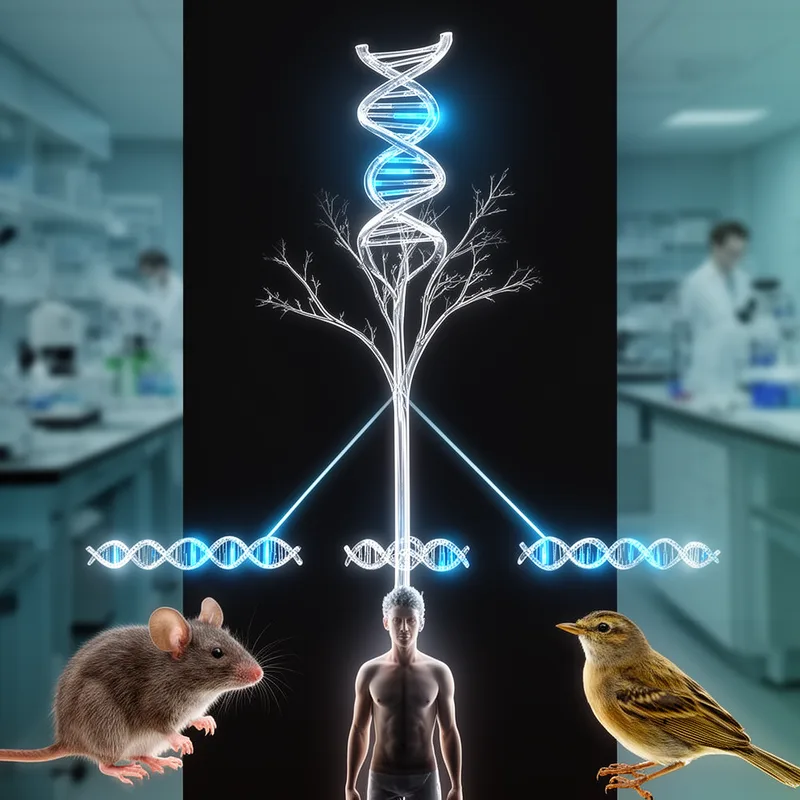
Researchers examined the gene orthology to understand evolutionary relationships across species.
-
The study of orthology helps scientists identify genes that have similar functions in different organisms.
-
By analyzing gene orthology, biologists can trace the lineage of genetic traits between various species.
Surface Forms
Morphology
orthology = ortho + logy
Although the form looks like the learned elements ortho- and -logy, the biological sense is a specialized technical term that an average learner would not be able to infer from the components.
Etymology
Orthology in biology comes from Greek parts ortho- meaning 'straight' or 'correct' and -logy meaning 'study', the same ortho- you see in orthodontist and orthodox. So in biology orthology is the study of genes that are the 'correct' matching genes across different species.