
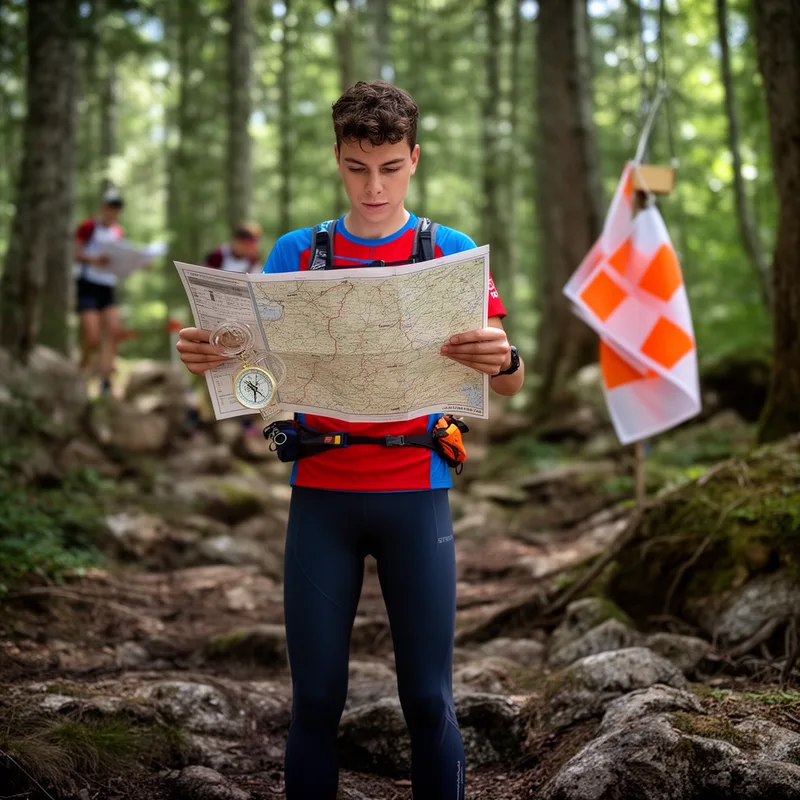
orienteer


 1
6.9
- noun
- /ˌɔːriənˈtɪr/
- In our sample, the adult orienteers often came from technical fields, whereas adult non-orienteers were largely college students who may have had less technical background.
- orienteers and non
- orienteers versus non
Examples
-
And finally, orienteers who had more experience did better than orienteers who had less experience.
Academic text (2003) -
As reported in the second part of the analysis, within the orienteer sample there was a difference between less and more experienced individuals.
Academic text (2003) -
Performance of the orienteers was similar for the three modes.
Academic text (2003) -
Beginning orienteers generally have clues that are written as phrases or single words.
Academic text (2003) -
A clue sheet is a listing of the features that an orienteer is supposed to find sequentially in the woods.
Academic text (2003) -
Among the orienteers, people recognized orienteering items with pretty much the same accuracy across the three methods.
Academic text (2003) -
Orienteers, who had more experience with the definitions, words, and symbols used, did better than non-orienteers did.
Academic text (2003) -
Murakoshi (1994) showed that experienced orienteers more accurately reported information about map features, such as their size.
Academic text (2003) -
We approached participants who were recruited at orienteering events (orienteers) individually and asked them to participate in a short survey about orienteering.
Academic text (2003) -
Davis is the top-ranked female orienteer in my home state.
Surface Forms
Morphology
Etymology
Orienteer comes from orient, a word that once meant 'east' or 'to face the sunrise' and later came to mean 'to find direction', as in orientation. So an orienteer is a person who finds their way across land using a map and compass.