
organometallic compound
- noun
- /ˌɔrɡənəˈmɛtəlɪk ˈkɑmpaʊnd/
- Specialized
- Many organometallic compounds are used in catalysis.
Examples
-
The unique properties of each organometallic compound depend on the metal and the organic groups involved.
-
Research in catalysis often focuses on the synthesis of new organometallic compounds.
-
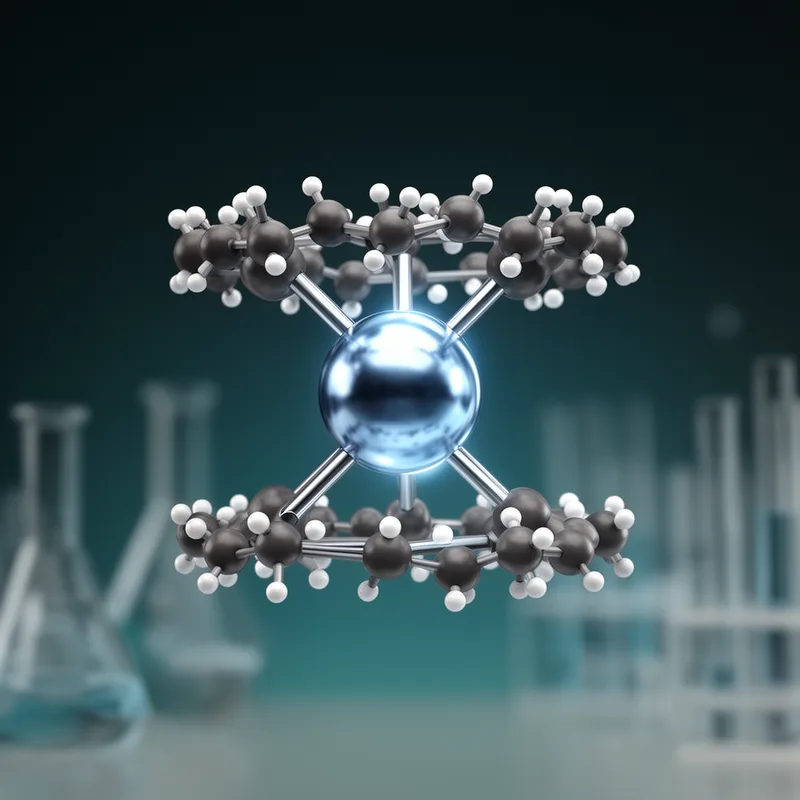
Ferrocene is a classic example of an organometallic compound featuring iron bonded between two cyclopentadienyl rings.
-
An organometallic compound contains a metal bonded to carbon.
-
An organometallic compound like methyl lithium is often used in organic synthesis for its strong reactivity.
-
Researchers are studying the properties of an organometallic compound that contains a direct bond between carbon and iron.
-
These organometallic compounds have shown great potential in catalyzing various chemical reactions in laboratories.
Synonyms

A chemical that has a metal atom joined directly to a carbon atom in an organic part
Surface Forms
Morphology
The phrase is a straightforward adjective + noun: 'organometallic' specifies having metal–carbon bonds and 'compound' denotes a chemical substance, so the meaning "a compound containing metal–carbon bonds" is directly derivable from the parts. Although technical vocabulary, the compositional structure and transparent morphemes (organo-, metal) follow regular English formation, making it predictable for learners who know the constituent words.
Etymology
The term organometallic compound joins organic, meaning carbon-containing groups, and metal. Imagine a metal atom 'holding hands' with a carbon group. Because they are directly connected, the name means a molecule where a 'metal' is joined to a 'carbon' part.

