
organ of Corti


 1
8.7
1
8.7
- noun
- /ˈɔrɡən əv ˈkɔrti/
- Specialized
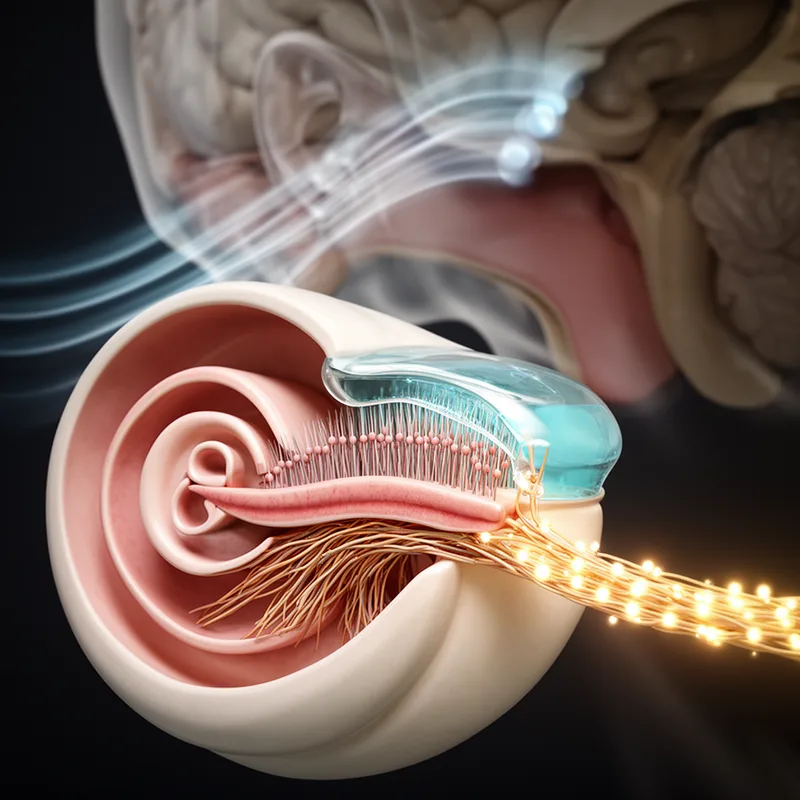
- The organ of Corti is covered with many fine hairs.
- cells in the organ of Corti
Examples
-
The function of the organ of Corti is essential for our ability to hear different frequencies of sound.
-
For example, 700 genes determine the structure and function of the organ of Corti alone.
Academic text (2008) -
The cellular and structural arrangement of cells in the organ of Corti has been well studied and, for the most part, appears similar across species.
Academic text (1998) -
It is below the semicircular canals, is also filled with fluid, and contains the organ of Corti.
Academic text (1990) -
An ideal treatment for permanent hearing loss would be based on the regeneration or replacement of damaged hair cells and would be directed toward the site of the lesion—that is, the organ of Corti.
Academic text (2004) -
To accomplish this, we dissected the organ of Corti (OC) from newborn Sprague-Dawley rats and cultured the OCs in medium overnight for recovery.
Academic text (2008) -
The organ of Corti contains the hair cells that are responsible for converting sound vibrations into nerve signals.
-
Damage to the organ of Corti can lead to permanent hearing loss due to the loss of sensory hair cells.
Surface Forms
Morphology
organ + of + Corti
The compound follows a transparent pattern ('organ of X') so a learner who knows 'organ' and 'of' can infer it is an anatomical structure named after 'Corti'. However, 'Corti' is an eponym with no semantic cue about location or function, so the specific sense (a cochlear sensory organ for hearing) cannot be derived without specialist knowledge. The naming pattern is cross-linguistically common but insufficient to convey the detailed meaning.
Etymology
Organ of Corti is named after the Italian doctor Alfonso Corti, who first described a tiny, important structure inside the ear. The name literally means the organ that belonged to Corti, and today it refers to the small part that turns sound into nerve signals for 'hearing'.