

order Lyginopteridales
- noun
- Specialized
- The order Lyginopteridales includes some of the earliest known seed ferns.
Examples
-
Many species of order Lyginopteridales resembled both ferns and seed plants.
-
Paleobotanists have found fossils of order Lyginopteridales in several Devonian rock layers.
-
The order Lyginopteridales existed millions of years ago.
-
Scientists study the order Lyginopteridales to learn about ancient ecosystems.
-
Paleobotanists have found fossils of order Lyginopteridales in several Devonian rock layers.
-
The order Lyginopteridales includes some of the earliest known seed ferns.
-
Scientists study the order Lyginopteridales to learn about ancient ecosystems.
Synonyms

A fossil plant like a fern that makes seeds and grows as a tree or climber from long ago
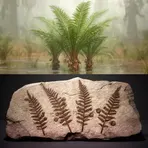
A group of extinct seed plants like ferns that lived a very long time ago
Surface Forms
Morphology
This is fully compositional: 'order' (a taxonomic rank) combined with the taxon name 'Lyginopteridales' yields the meaning 'the taxonomic order of the Lyginopteridales'. Biological naming conventions of rank + taxon are regular and cross-linguistically familiar, so a learner who knows both constituents can derive the meaning. Although the taxon name is specialized, the structure and semantics are predictable rather than idiomatic.
Etymology
Order Lyginopteridales groups ancient plants called seed ferns that looked like ferns but made seeds instead of spores. Imagine a plant with fern leaves that also makes seeds — that clear picture is why the name refers to an extinct group of fossil seed-producing plants from the Devonian period.

