
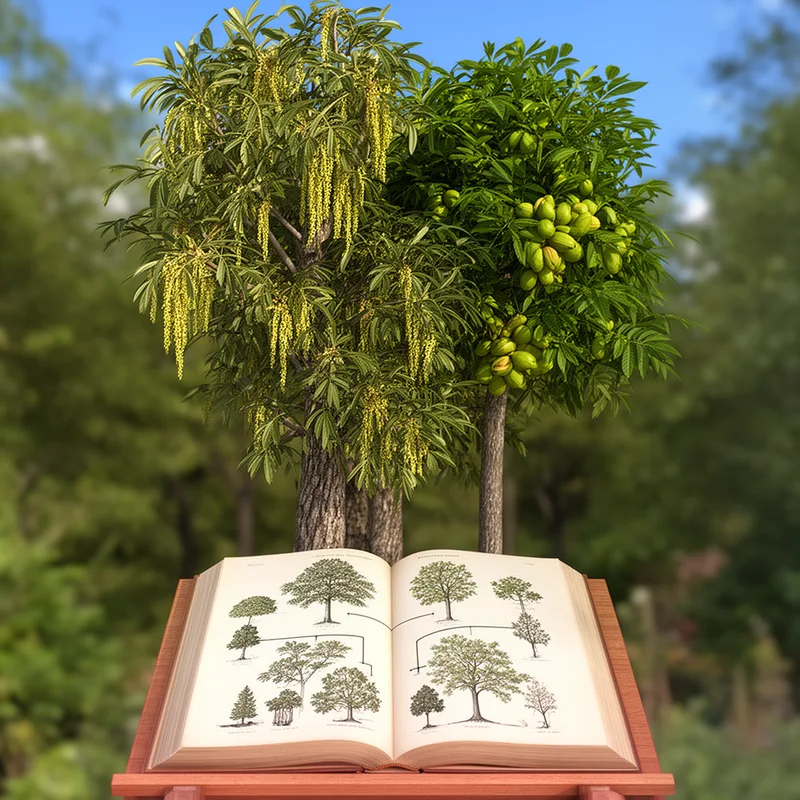
order Juglandales
- noun
- /ˈɔrdər ˈdʒʌɡləndeɪlz/
- Archaic
- The order Juglandales contains nut-bearing trees such as walnuts and hickories.
Examples
-
Many botanists now classify species from the order Juglandales within other taxonomic groups.
-
The classification of the order Juglandales has changed with advances in genetic research.
-
The order Juglandales includes various trees and shrubs.
-
Many species in the order Juglandales are economically important.
-
The order Juglandales comprises families known for their distinctive nut-producing species.
-
Researchers are studying characteristics of the order Juglandales, which includes popular trees like walnuts.
-
In botanical studies, the order Juglandales refers explicitly to the group containing hickories and walnuts.
Synonyms
A group of flowering trees and shrubs that includes walnuts and hickories
Surface Forms
Morphology
The phrase is fully compositional: 'order' (a taxonomic rank) combined with the proper name 'Juglandales' directly yields the meaning 'the taxonomic order called Juglandales'. This naming pattern is standard in biology and cross-linguistically common, so a B1 learner who knows both constituents would be able to infer the MWE's meaning (noting only that the domain is specialized vocabulary).
Etymology
Order Juglandales comes from the Latin name Juglans for the walnut and the ending -ales that plant scientists use to name an 'order' of related plants. So the name points to a group of walnut-like trees such as walnuts and hickories.

