
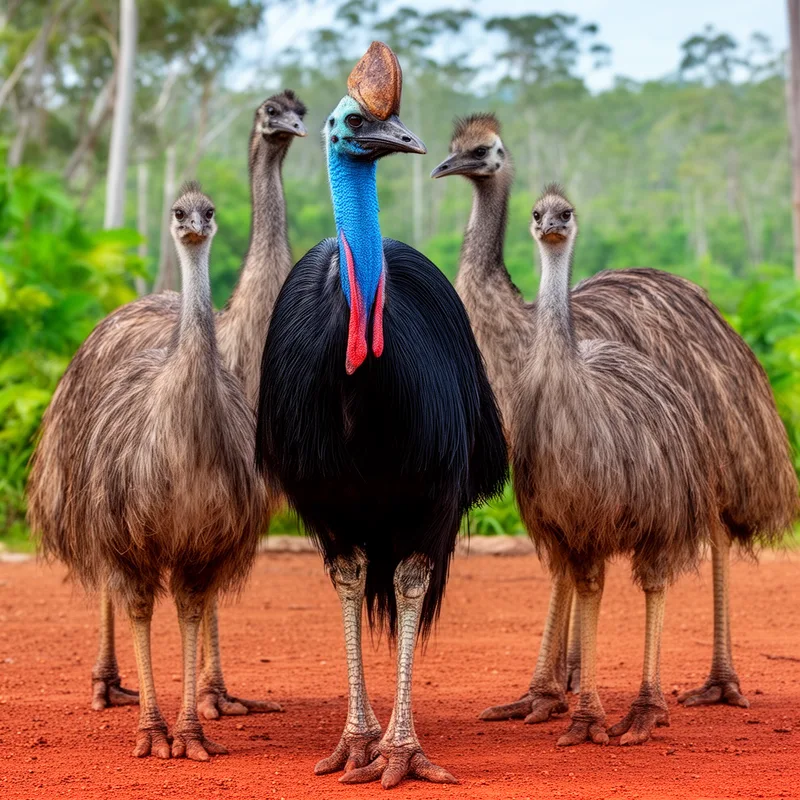
order Casuariiformes
- noun
- /ˈɔrdər ˌkæzʊˌɛrɪˈfɔrmiːz/
- Specialized
- The order Casuariiformes consists of large, flightless birds found primarily in Australia and New Guinea.
Examples
-
Scientists have been studying the evolution of the order Casuariiformes to understand the loss of flight in birds.
-
The order Casuariiformes includes some of the largest flightless birds.
-
Both cassowaries and emus are members of the order Casuariiformes, sharing similar anatomical features.
-
Did you know that the order Casuariiformes consists of cassowaries and emus?
-
Both cassowaries and emus are members of the order Casuariiformes, sharing similar anatomical features.
-
Scientists have been studying the evolution of the order Casuariiformes to understand the loss of flight in birds.
-
The order Casuariiformes consists of large, flightless birds found primarily in Australia and New Guinea.
Synonyms

A group of large flightless birds like emus and cassowaries from Australia and New Guinea
Surface Forms
Morphology
This is fully compositional: 'order' denotes a taxonomic rank and 'Casuariiformes' is the taxon name for Australasian large flightless birds, so a learner who knows both constituents can directly infer it refers to that taxonomic group. The construction follows standard, cross-linguistically common noun + proper-name taxonomy patterns, making the meaning immediately transparent.
Etymology
Order Casuariiformes gets its name from Casuariiformes, a word based on the name for the cassowary because this order groups big, flightless birds such as cassowaries and emus. So, the name means a 'group of cassowary-like birds', which is why it refers to that scientific group today.

