

oliphant
- noun
- /ˈoʊlɪfənt/
- Archaic
- The hunter blew the oliphant to signal the beginning of the chase.
- oliphants carved
- ivory oliphants
- Portuguese oliphants
Examples
-
A single large lug, carved out of the tusk on the convex side, allows the oliphant to be suspended by a string (suggesting European influence).
Academic text (1994) -
The eight ivory horns, or oliphants, which form the subject of the present article, are individually not well documented.
Academic text (1999) -
Archives do not throw light on the oliphant's early history.
Academic text (1994) -
In my opinion, it suggests that Sapi-Portuguese oliphants were still sought after in Europe at the end of the sixteenth century.
Academic text (1994) -
The centaur's tail is double-tufted, as seen on other oliphants carved by different artists.
Academic text (1994) -
The earliest presence in Europe of an oliphant from this group (aside from Sloane's rediscovered horn) is documented unequivocally by a watercolor painted before 1666.
Academic text (1994) -
In its size and simple decoration (the coat of arms of the reigning House of Aviz in Portugal, the Cross of the Order of Christ, and two animals), the oliphant may be compared to nos. 107 and 108 in Africa and the Renaissance.
Academic text (1994) -
Historians believe that the oliphant was a prized possession among nobles during medieval times.
-
An ancient oliphant adorned with intricate carvings was discovered in the castle's hidden chamber.
Synonyms



 1
9.9
1
9.9
A long wooden horn played by mountain herders to send sound across valleys

A long curved bronze horn used in old northern European ceremonies
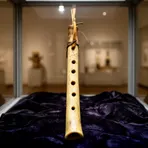
An old wind instrument with a single reed often made from bone that people no longer use
How Big

Surface Forms
Etymology
Oliphant comes from an old word meaning 'elephant', and people often made horns from an elephant's tusk; like the modern word elephant, it kept its link to the animal. So an oliphant came to mean a large hunting or war horn made from ivory.