
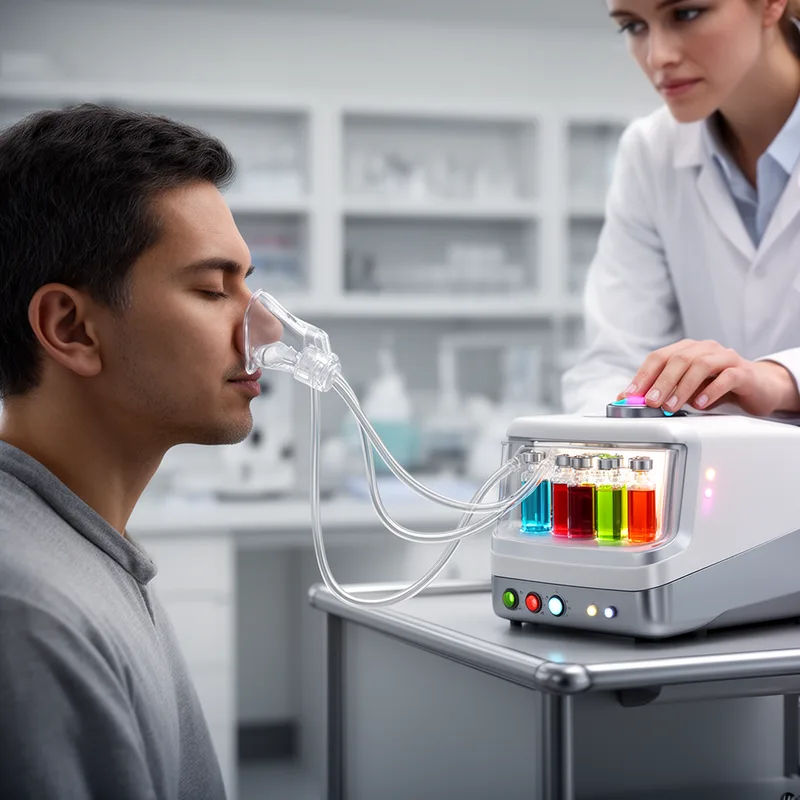
olfactometer


 1
9.9
- noun
- /ɒlˈfæktəˌmɛtər/
- Specialized
- Olfactometer bioassays are used to identify the specific chemicals that attract moths to feed on plant nectars.
- use an olfactometer
Examples
-
An olfactometer, the device used for odor panel testing, contains three sniffing ports (similar to tubes).
Academic text (1995) -
Mosquito responses were favorable in the olfactometer, but the human hand still attracted the most.
Academic text (2000) -
To test the appeal of various volatiles, Beerwinkle and coworkers developed a device called an olfactometer.
Academic text (1994) -
Entomologist Donald Barnard demonstrates the attraction of female yellow fever mosquitoes to his hand in an olfactometer.
Academic text (2000) -
They use an olfactometer, a cage separated by a screen, where mosquitoes are placed on one side and an attractant is pumped through the other, to see if mosquitoes will come to the screen.
Academic text (2000) -
The researchers measured the insects' response to different odors using an olfactometer designed for such experiments.
-
An olfactometer is a specialized tool that helps scientists evaluate a person's ability to detect various smells.
-
In the lab, students learned how to operate an olfactometer to test their sense of smell with various fragrance samples.
Surface Forms
Morphology
olfactometer = olfacto + meter
This is a technical formation meaning 'smell-measuring device', but the combining form 'olfacto-' is not a common standalone English element for most learners.
Etymology
Olfactometer comes from the Latin root olfact-, from olfacere meaning 'to smell', plus -meter meaning 'to measure', as in thermometer. So an olfactometer is a tool that 'measures smell', like a ruler for the nose.