
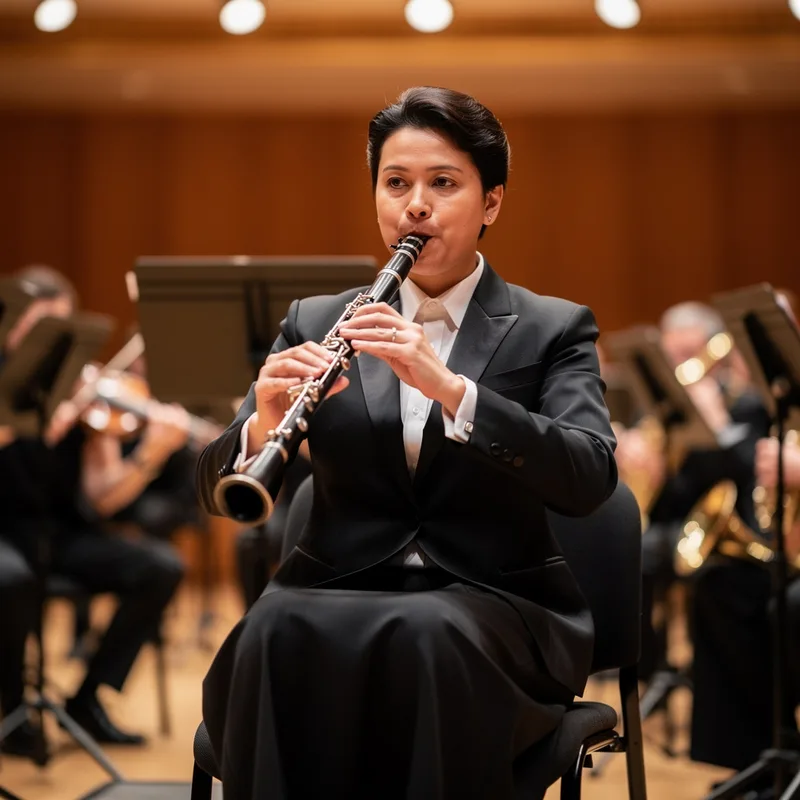
oboist
 2
6.1

- noun
- /ˈoʊboʊɪst/
- In the woodwind sections, women substantially increased their representation as oboists, English horn players, and bassoonists between the 1940s and the 1980s.
- the principal oboist
- the first oboist
Examples
-
Clarinetist Alejandro T. Acierto and oboist Andrew Nogal moved like robots, picking up, playing, and putting down their instruments with precise deliberation.
Blog text (5) -
Well, the principal oboist is a big fan.
-
The oboist started to cut another reed, even though she had two already cut.
Fiction book (1994) -
Rachel was an oboist, and she often seemed not to have too much truck with the ordinary world.
Fiction book (1997) -
He was really a fully formed oboist in his first week, winning the annual etude competition in his first term.
Blog text (18) -
Marie joins Klimt in his balcony box as the concertmaster asks the oboist to play his "A."
Fiction book (1990) -
The oboist played a beautiful melody that captivated the audience.
-
During the concert, the solo oboist showcased her skills with an impressive performance.
-
As a talented oboist, he often collaborated with other musicians in local orchestras.
Surface Forms
Morphology
Etymology
Oboist comes from oboe + -ist, and oboe itself comes from the French hautbois, which means 'high wood'. So an oboist is 'one who plays' that 'high wood' instrument, like a pianist is someone who plays the piano.