
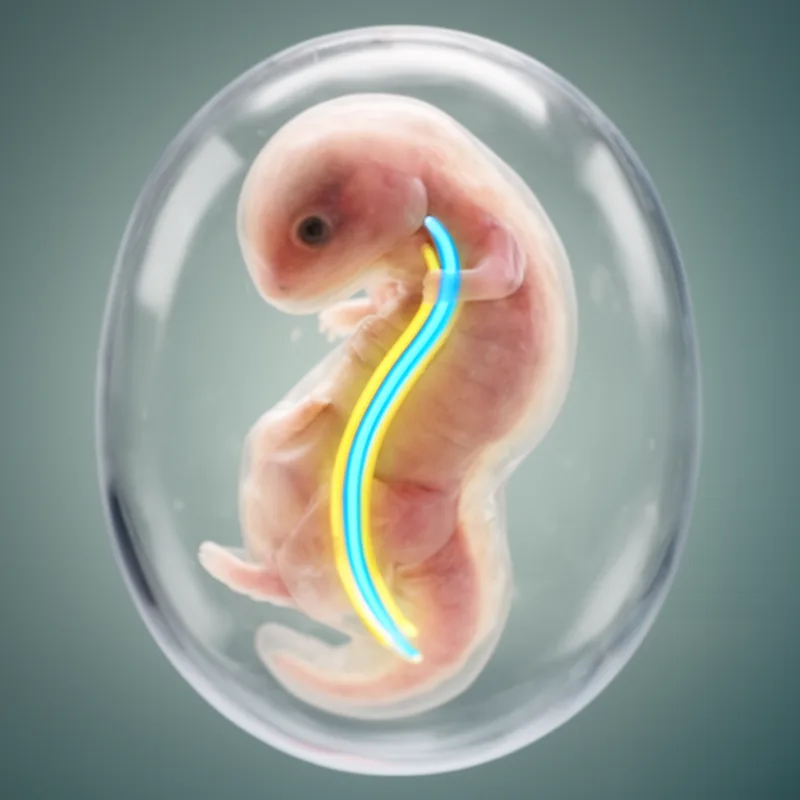
notochord
 1
9.9

- noun
- /ˈnoʊtəˌkɔrd/
- Specialized
- Before vertebrates developed a bony spine, a notochord was present as the main support for their bodies.
Examples
-
More remarkably, tunicates have larvae that resemble tadpoles, complete with a dorsal nerve cord and a rudimentary backbone called a notochord.
Academic text (1992) -
OK, we'll get to notochord and neural tube very soon.
-
Now, a lot of these processes depend on molecules that come from the notochord that induce these changes.
-
Perhaps the chordate crowd with their notochords, segmented muscles and big Bony skeletons.
-
We have the somite seal, the notochord, the endoderm, the ectoderm, and two primordia of the dorsal ERTA.
-
The notochord penetrated the brain case to the level of the pituitary gland, and a series of extrascapular dermal shoulder girdle bones were attached to the dermal head shield.
Academic text (2003) -
In the embryos of vertebrates, the notochord acts as a flexible rod that provides essential support during early development.
-
Many primitive chordates possess a notochord that serves as the primary support structure of their bodies.
Surface Forms
Morphology
Etymology
Notochord comes from the Greek parts noto- meaning 'back' and chord meaning 'string' or 'cord'. So a notochord is literally a 'back cord', a flexible 'string' along an embryo's back that gives support until the backbone forms.