
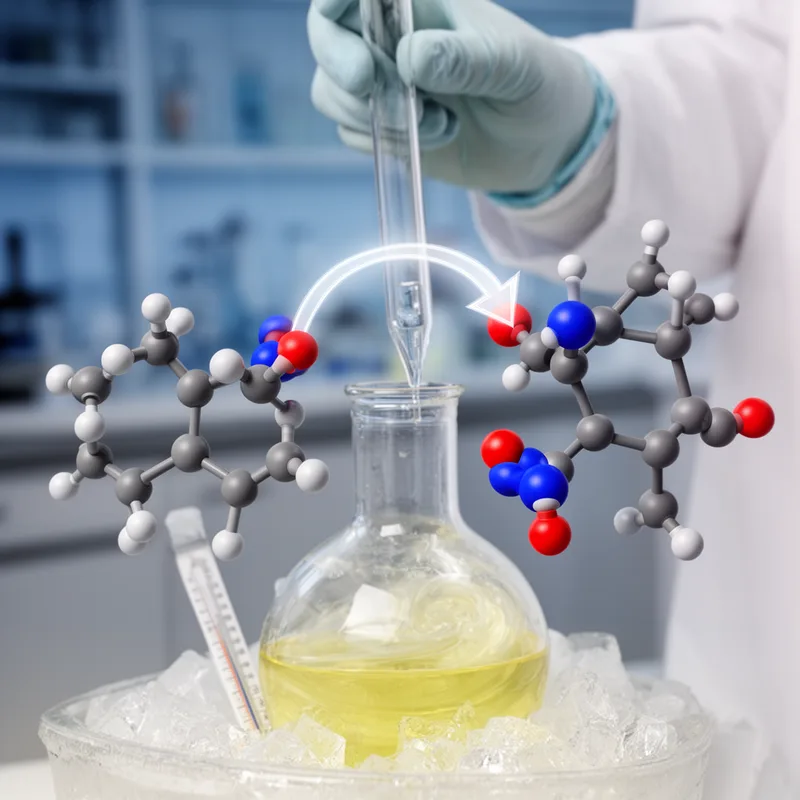
nitration


 1
8.2
- noun
- /naɪˈtreɪʃən/
- Specialized
- Or if it's too reactive, remember that the rocket fuel was nitration of something like that.
- tyrosine nitration
- increase in nitration
Loading YouTube…
Watch on YouTubeSo indeed, this is a very, very active nitration reaction.
- So indeed, this is a very, very active nitration reaction.
Examples
-
So indeed, this is a very, very active nitration reaction.
-
The analysis of the tyrosine nitration was performed by immunofluorescence.
Academic text (2018) -
The results were expressed as the percentage of FITC-positive cells. Analysis of tyrosine nitration.
Academic text (2018) -
Tyrosine nitration has been associated with at least 50 human diseases affecting protein structure and function, being considered an essential feature of peroxynitrite-mediated cytotoxicity.
Academic text (2018) -
These results indicate that peroxynitrite caused an increase in tyrosine nitration in human spermatozoa, which was evident after 4 hours of incubation.
Academic text (2018) -
In our experimental settings, the basal level of tyrosine nitration was significantly increased in spermatozoa after 4 hours of peroxynitrite exposure.
Academic text (2018) -
For analysis of tyrosine nitration, Students' t-test was applied, and for TEM analysis, the Mann-Whitney comparison test was performed. P < 0.05 was considered statistically significant.
Academic text (2018) -
These markers include MPT induction, tyrosine nitration, and loss of DNA integrity without PtdSer externalization or caspase activation.
Academic text (2018) -
The process of nitration is crucial in the production of various explosives.
-
Researchers conducted an experiment to study the effects of nitration on cell proteins.
Synonyms
 1
8.8
A chemical process that adds a nitro group to an organic molecule
Surface Forms
Morphology
Etymology
Nitration comes from the root nitro-, from the old word 'nitre' meaning 'saltpeter', and the ending -ation meaning 'the act of'. The nitro- part is the same as in nitrogen, so nitration means the act of adding a 'nitro' (a nitrogen-containing) part to a chemical.