
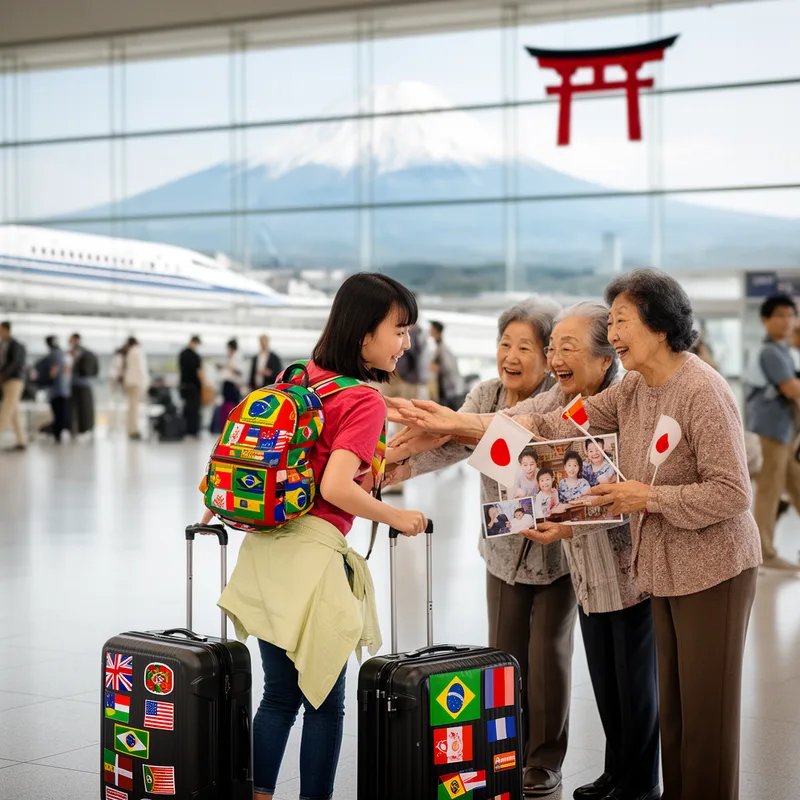
nikkeijin


 1
9.9
- noun
- /nɪkˈkeɪdʒɪn/
- As far as some of them were concerned, I was like one of them—another nikkeijin dekasegi trying to earn money in Japan—except that I also happened to have research motives as well.
- nikkeijin dekasegi
- Brazilian nikkeijin
- American nikkeijin
Examples
-
In addition, I was directly sharing the experiences of the Japanese-Brazilians in Japan by assuming the status of a nikkeijin dekasegi and working alongside them on the assembly line.
Academic text (1998) -
Most of the Brazilian nikkeijin are treated as "foreigners" in Japan because they cannot (or will not) speak or act Japanese and are therefore ethnically rejected and excluded from Japanese social groups.
Academic text (1998) -
For these various reasons, I saw the American nikkeijin as people with a different ethnic and historical background who had lost much of the Japanese language and their Japanese consciousness by the second and third generation.
Academic text (1998) -
"Actually," I would continue, "I'm a graduate student from the University of California conducting research on Brazilian nikkeijin dekasegi."
Academic text (1998) -
This immediately symbolized our ethnic solidarity and similar status as nikkeijin dekasegi, further ensuring my ethnic acceptance.
Academic text (1998) -
Not only was the presentation of my personal ethnic identity ambiguous, I was naturally seen and treated more as a nikkeijin worker than someone who was ethnically closer to the Japanese.
Academic text (1998) -
This resulted in a conflict between my inner sense of self (as a "Japanese" and as an anthropologist) and the manner in which I was perceived by the Japanese workers through the standard social roles of nikkeijin and dekasegi.
Academic text (1998) -
This made me aware of the cultural differences that were the product of my American upbringing as a "nikkeijin," a sentiment that was reinforced by feelings of ethnic affinity and commonality I felt with the openly receptive Brazilian nikkeijin.
Academic text (1998) -
Most notable and prominent among the numerous groups of foreigners that have flocked to the region in recent years are the Japanese-Brazilian nikkeijin (former Japanese emigrants and their descendants born abroad).
Academic text (1998) -
Many nikkeijin move back to Japan to reconnect with their cultural roots.
Synonyms
Surface Forms
Etymology
Nikkeijin comes from Japanese parts nikkei ('Japanese roots') and jin ('person'). So, nikkeijin means 'a person with Japanese family background', which is why the word is used for people who return to live in Japan from another country.