
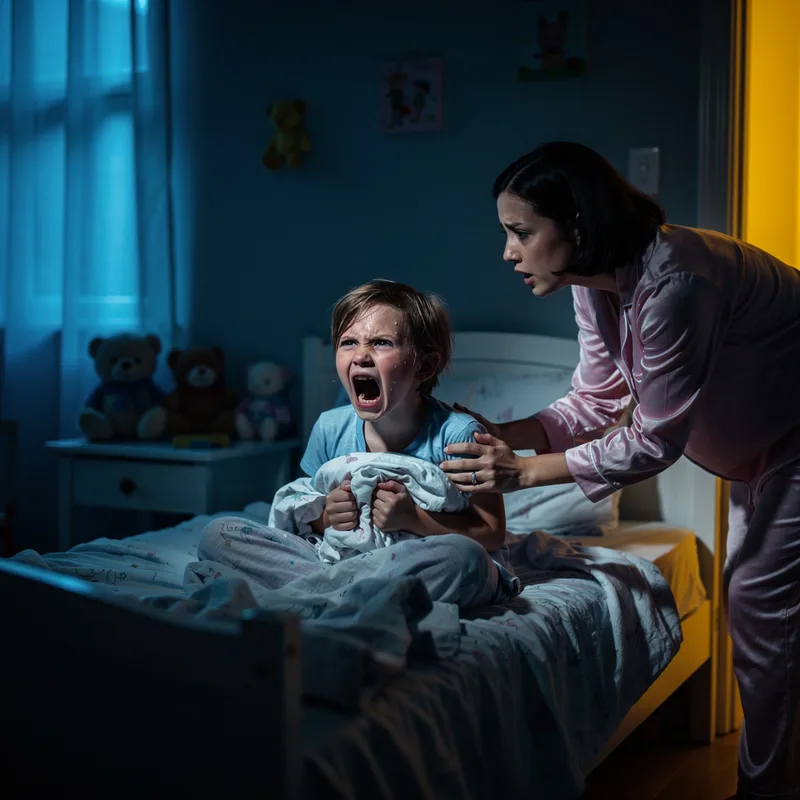
night terror
 22
7.8
22
7.8

- noun
- /naɪt ˈtɛrər/
- Specialized
- It can be difficult to tell the difference between a night terror and a nightmare.
- suffers from night terrors
- experiencing night terrors
- children with night terrors
Loading YouTube…
Watch on YouTubeHe's still having these night terrors, and they keep getting worse.
- He's still having these night terrors, and they keep getting worse.
- Did he find any overlaps with those people and with his current knowledge of child psychology or, or, you know, like night terrors with children?
- People who have night terrors or who have who sleepwalk should not take theanine.
- I I can't say no, but I'd be like I have night terrors.
- Like I had even night terrors, like at night to sleep on my own with the lights off.
Examples
-
We had to take him to a child psychologist to help him deal with his night terrors.
-
Lack of sleep, or being overtired, can cause an increase in night terrors for your young child.
Blog text (2) -
A night terror typically looks as if your child is not himself, which often concerns parents.
Blog text (2) -
According to Healthy Children, children do not remember anything about the night waking or night terror.
Blog text (2) -
Did I ever tell you about the night terrors I used to have?
-
Kyle had night terrors again last night.
-
One of the best remedies for night terrors is putting your child to sleep at an earlier time.
Blog text (2) -
My son Jeffrey started waking up night after night screaming with night terrors.
-
Parents who attempt to combat night terrors without consulting a physician do their children a profound disservice.
Academic text (1996) -
My 3-year-old has been having night terrors for over a year, several times a night.
Synonyms
 11
3.5
11
3.5
A health problem that stops a person sleeping normally

A sleep problem with sudden intense fear, screaming, and panic during deep sleep

A sleep problem where someone wakes from deep sleep with intense fear and often screams, usually without memory
How Severe
- Specialized
22
7.8
 404
1.5
404
1.5
Surface Forms
Morphology
The compound 'night terror' is transparently built from 'night' + 'terror' and an average B1 learner who knows both words can infer it refers to an episode of intense fear occurring at night. While the clinical specifics (sleep-disorder status, typical occurrence in children, lack of memory) are not fully deducible, the core sense is compositional and cross-linguistically relatable.
Etymology
Night terror paints a clear picture: night and sudden terror, like a child who wakes in the night screaming and very afraid. That's why it means 'a sleep problem when someone wakes very frightened but usually does not remember it'.