
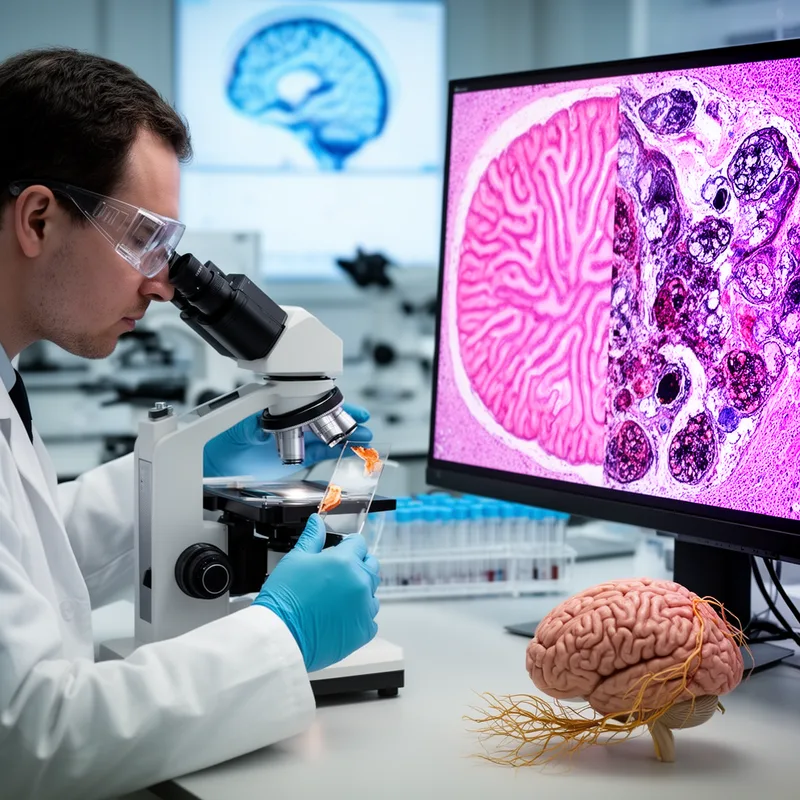
neuropathology
 1
7.4

- noun
- /ˌnʊroʊpəˈθɑlədʒi/
- Specialized
- The study of neuropathology is essential for understanding diseases that affect the nervous system.
Examples
-
This phenomenon also reminds us that delusional interpretations of circumscribed anomalies of experience arising from neuropathology are not confined to schizophrenia.
Academic text (1999) -
NEUROPATHOLOGY
Academic text (2003) -
My focus is Neuropathology, the examination of the brain.
-
There is evidence from neuropathology that suggests disorders that specifically attack that sense of that aspect of the self.
-
A hundred years would pass before modern neuropathology would even allow us to actually locate the damage in the Parkinsonian brain.
-
It'll take time, but I think it will be, it will make neuropathology quantitative and precise in terms of of of research.
-
...conditional bioflavonoid neuropathology.
-
While at Hopkins, Marui studied psychobiology and neuropathology, but found himself interested in reading the works of Freud in the library of Meyer's department.
Academic text (1990) -
Your discovery of the white cellular clotting predominance in neurasthenia... completely altered my understanding of... conditional bioflavonoid neuropathology.
-
Several groups have developed transgenic models that overexpress the amyloid precursor protein or beta-amyloid and then develop AD-like neuropathology.
Academic text (1995)
Surface Forms
Morphology
neuropathology = pathology (transparent) = neuro + patho + logy
This is a standard medical formation meaning pathology of the nervous system, so the sense follows directly from the base word.
Etymology
The word neuropathology comes from neuro- meaning 'nerve', as in neurologist, and pathology meaning 'the study of disease'. So, neuropathology is the scientific study of diseases and damage in nerve and brain tissue.