
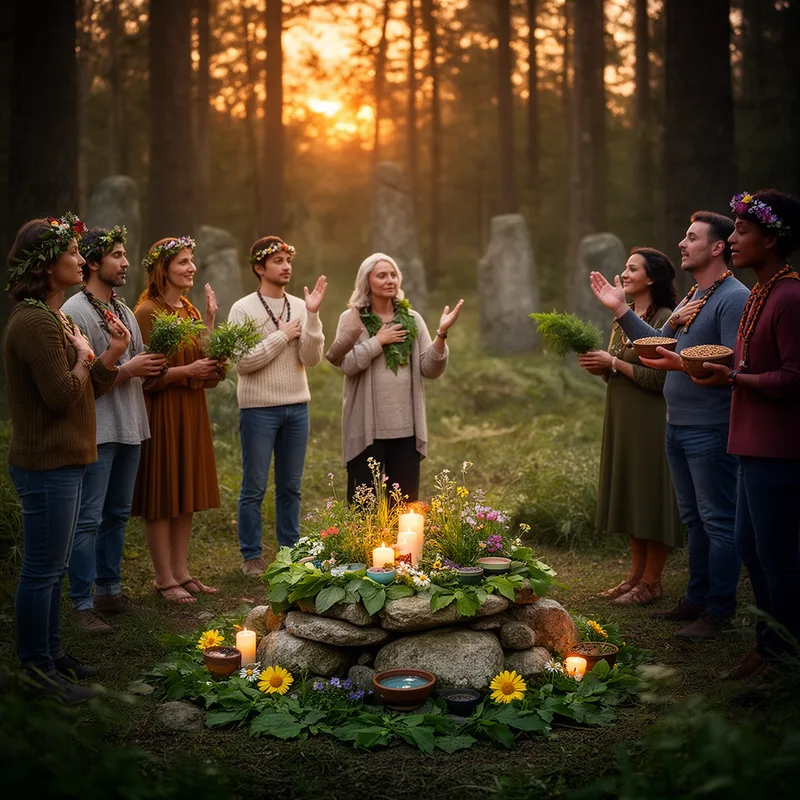
neopagan


 1
8.1
1
8.1
- adjective
- /ˈniːoʊˌpeɪɡən/
- Many people are turning to neopagan beliefs to explore spirituality rooted in nature and ancient traditions.
- neopagan paradigm
Examples
-
It is inextricably linked with two other phenomena that share its nineteenth-century European origin: neopagan occultism and the radical feminist political agenda.
Academic text (1993) -
He began writing in a neopagan vein but developed his full set of beliefs only after becoming involved in Theosophy.
Academic text (1993) -
The centrality of Gardner's work to the current neopagan revival is recognized by many major figures within the movement itself.
Academic text (1993) -
It is squarely within the Neopagan paradigm.
Academic text (1993) -
I find that a great deal of Neopagan ritual is discursive, sometimes verbose, and at its worst didactic.
Blog text (32) -
As a form of organized religion, neopagan Goddess spirituality has its home in Wicca, modern witchcraft.
Academic text (1993) -
While we have had to give brief consideration to quite a variety of movements, a common pattern of thought emerges from them, which I have dubbed the Neopagan Paradigm.
Academic text (1993) -
That today's matriarchalists subscribe to a version of the Neopagan Paradigm is obvious from their reconstructions of history.
Academic text (1993) -
The Neopagan Paradigm amounts to this: Ancient and/or non-Western paganism was great and good; indeed, it has the potential to solve our own greatest problems, whether personal, social, or ecological.
Academic text (1993) -
The neopagan community often celebrates seasonal festivals that reflect ancient cultural practices.
Surface Forms
Morphology
Etymology
Neopagan is made of neo- meaning 'new' and pagan meaning 'old nature-based beliefs or non-Christian traditions'. So, as an adjective, neopagan describes modern or revived forms of those old beliefs.