

naval gun
- noun
- /ˈneɪvəl ɡʌn/
- Specialized
- In training exercises, the crew learned to operate the naval gun effectively to improve their combat readiness.
- inch naval gun
Loading YouTube…
Watch on YouTubeInstead, the Ottomans simply withdrew in good order, beyond the range of Italian naval guns.
- Instead, the Ottomans simply withdrew in good order, beyond the range of Italian naval guns.
Examples
-
For a June 5 landing, air support would be impossible and naval guns would be hard to handle.
Academic text (1994) -
This could be accomplished by using high-flying aircraft, naval guns, or giant balloons.
Academic text (2009) -
During the battle, the naval gun fired accurately at enemy positions, helping to secure a strategic advantage.
-
The ship was equipped with advanced naval guns, which were crucial for launching powerful attacks against hostile forces.
Synonyms
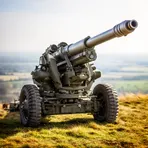
 ∞
1.0
∞
1.0

A weapon that fires bullets or shells at high speed
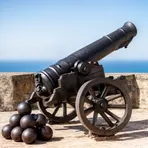 103
3.9
103
3.9
A large heavy gun often on wheels or ships that fires heavy shells
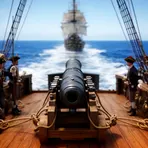

 1
9.9
1
9.9
A gun at the back of a ship used to fire at a chasing ship
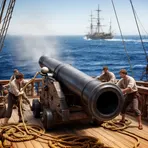
A large gun on a ship with a long barrel used in sea battles

A short heavy cannon on a ship used to fire at enemy ships at close range
How Powerful

Surface Forms
Morphology
The noun phrase is directly compositional: 'naval' means 'associated with the navy' and 'gun' means a firearm or artillery piece, so together they denote a gun used by or mounted on a warship. This adjective+noun pattern is regular and cross-linguistically common, so a B1 learner who knows both constituents will readily infer the MWE's meaning.
Etymology
The noun naval gun comes from the simple image of a big gun placed on a naval ship for battle. Sailors fired these heavy weapons from the deck, so naval gun came to mean 'a large gun on a warship'.