
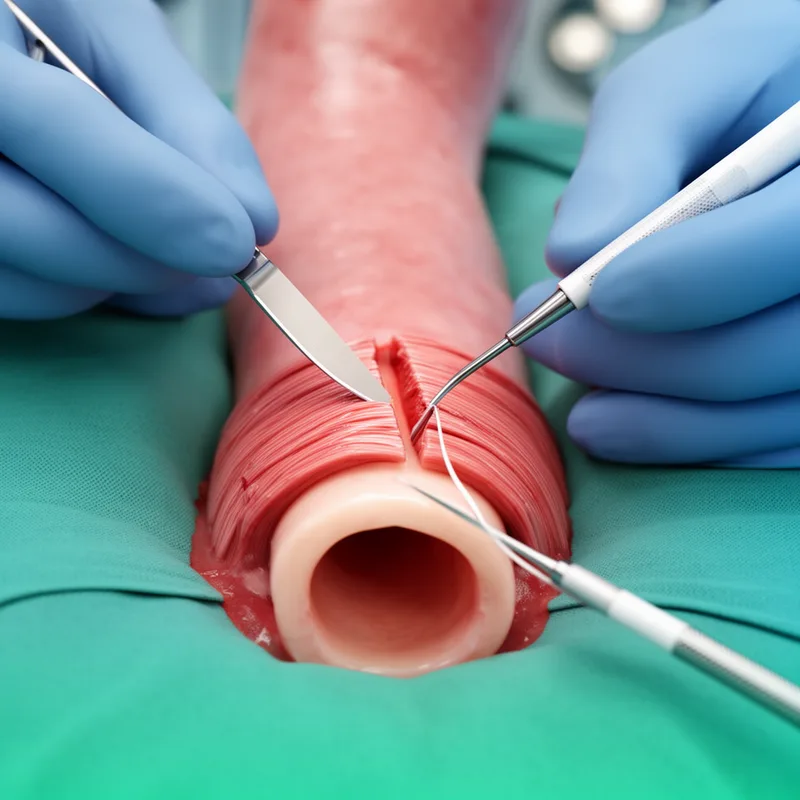
myotomy
- noun
- /maɪˈɒtəmi/
- Specialized
- The surgeon explained that a myotomy might be necessary to relieve the patient's swallowing difficulties.
- hyoid myotomy
- myotomy and suspension
- advancement and hyoid myotomy
Examples
-
The critical aspect of all endoscopic techniques is the accomplishment of a complete cricopharyngeal (CP) myotomy.
Academic text (2010) -
The myotomy site is inspected for completeness and sealing of the wound edges (Figure 2). If necessary, a second activation can be performed to divide any remaining CP fibers.
Academic text (2010) -
The CP myotomy method varies.
Academic text (2010) -
Figure 5. The hyoid myotomy and suspension procedure.
Academic text (1999) -
For these reasons, we perform hyoid myotomy and suspension only in some patients and only as a separate surgical step.
Academic text (1999) -
Figure 2. Endoscopic view shows intact buccopharyngeal fascia after completion of the myotomy.
Academic text (2010) -
Our initial experience suggests that the harmonic scalpel is safe, easy to use, and provides excellent visualization for CP myotomy in patients with a small ZD.
Academic text (2010) -
Although hyoid myotomy with suspension also improves hypopharyngeal obstruction and is included in the phase I surgical protocol, it is not always performed simultaneously with genioglossus advancement.
Academic text (1999) -
After the myotomy was performed, the patient's throat showed significant improvement in function.
-
Many patients experience less stress and anxiety after their myotomy procedure is successfully completed.
Surface Forms
Morphology
myotomy = myo + tomy
Built from technical Greek combining forms 'myo-' (muscle) + '-tomy' (cutting) that are not standalone English words, so learners cannot reliably derive the meaning from familiar English bases.
Etymology
Myotomy comes from the Greek parts myo- 'muscle' and -tomy 'cutting', like in appendectomy. So, it means 'cutting a muscle' and refers to a surgery that cuts a tight muscle to relieve pressure and help it work better.

