
myosin
 1
9.5

- noun
- /ˈmaɪəsɪn/
- Specialized
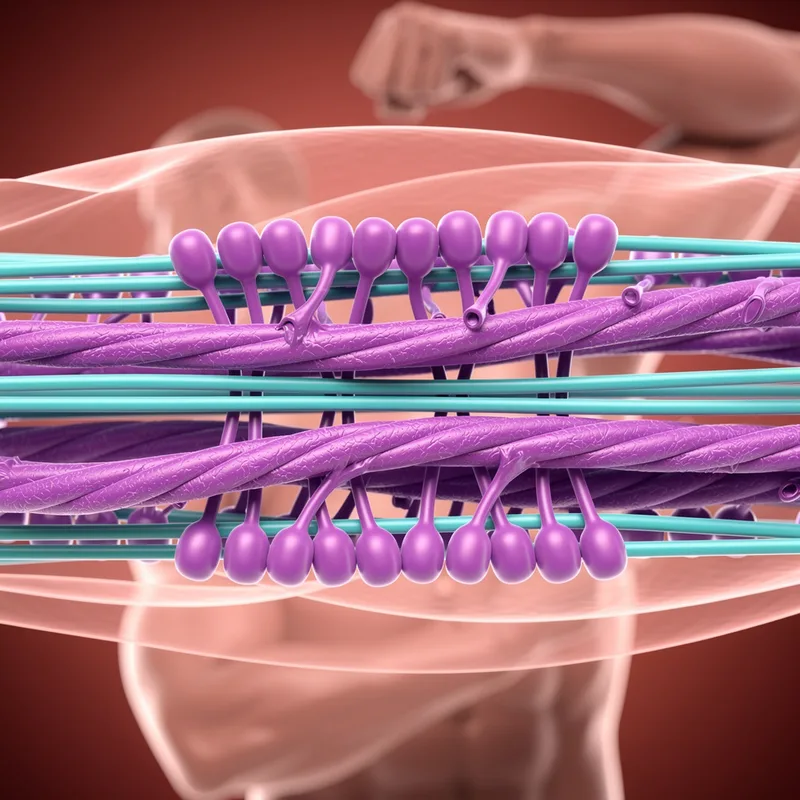
- Within these myofibrils are bundles of thick filaments, which are myosin, and thin filaments which are actin.
- myosin; paramyosin
- myosin and actin
- myosin-containing filaments
Loading YouTube…
Watch on YouTubeEstrogen is responsible for how strong myosin attaches to actin.
- Estrogen is responsible for how strong myosin attaches to actin.
- The bond between the cross bridge, the myosin actin gets stronger, the calcium affinity is the phrase that we use there increases.
Examples
-
Thick filaments contain myosin, and thin filaments are composed of actin.
Academic text (2005) -
And I'm going to focus on this cardiac myosin in this short talk.
-
It's best to start from the most basic level of mechanics with actin and myosin.
Blog text (20) -
Fiber recovery is complete when adult myosin has replaced all of the developmental myosin.
Academic text (2005) -
Stress fibers are mostly formed by actin and myosin.
Academic text (2017) -
Estrogen is responsible for how strong myosin attaches to actin.
-
Developmental myosin is an indicator of muscle recovery after damage (St. Pierre & Tidball, 1994).
Academic text (2005) -
The muscle fibers contract when myosin interacts with actin during physical activity.
-
In skeletal muscles, myosin and actin work together to produce movement.
-
Scientists investigate how myosin contributes to the contraction of muscle cells.
Surface Forms
Morphology
myosin = myo (opaque) = myo + in
The combining form 'myo-' is a specialised scientific element (not a familiar standalone word like 'muscle'), and the protein suffix '-in' is technical, so the sense is not derivable by an average B1 learner from common vocabulary.
Etymology
The word myosin comes from the Greek beginning myo- meaning 'muscle', a word that also once meant 'mouse' because people thought muscles looked like little mice under the skin, and the ending -in is used for proteins. So, myosin is a protein in muscles that helps them move.