
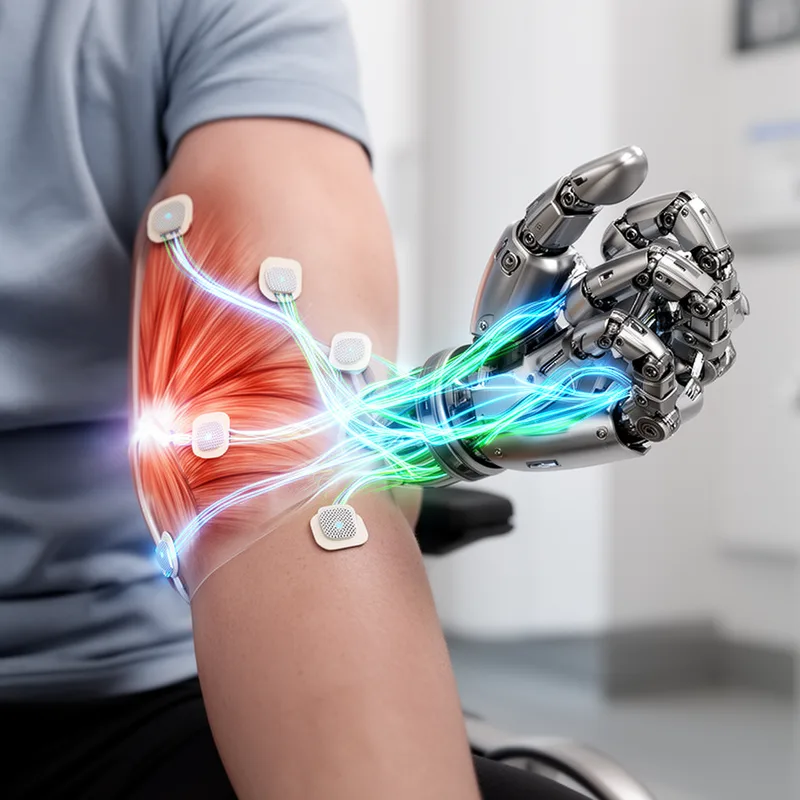
myoelectric
 1
8.2

- adjective
- /ˌmaɪoʊɪˈlɛktrɪk/
- Specialized
- Many operator performance studies have been conducted using myoelectric (ME) control systems for multifunction prostheses.
- myoelectric prosthesis
- myoelectric signal
- Myoelectric Control
Examples
-
In the early 1970s, electromechanical prostheses with myoelectric control were available for the upper limbs.
Academic text (2009) -
The first clinically significant myoelectric prosthesis was unveiled by Russian scientist Alexander Kobrinski in 1960.
Academic text (2014) -
Despite widespread availability, myoelectric technology is expensive and may not be covered by insurance plans
Academic text (2014) -
The test procedure requires the subject to complete a single, half-hour session of myoelectric control training.
Academic text (1990) -
The test procedure has two phases: myoelectric control training and prosthesis control testing.
Academic text (1990) -
The state-of-the-art is what we call myoelectric prostheses.
-
Group 1 used a control strategy implementing a three-state myoelectric control system for each of the controlling muscles.
Academic text (1990) -
In contrast to body-powered prostheses, however, myoelectric prostheses are externally powered and must be recharged regularly (22, 23).
Academic text (2014) -
The development of myoelectric prostheses has transformed the lives of many individuals with limb loss.
-
Doctors use myoelectric signals to control artificial limbs that respond to muscle movements.
Synonyms
 5
6.0
Relating to the electrical activity in living things
 2
6.4
Relating to electrical signals in living things
Surface Forms
Morphology
Etymology
The word myoelectric combines the Greek root myo- meaning 'muscle' and the familiar word electric, which refers to 'electricity'. So, myoelectric describes electrical signals or power that come from muscle activity.