

musical accompaniment
 1
3.6
1
3.6

- noun
- /ˈmjuːzɪkəl əˈkʌmpənɪment/
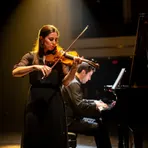
- During the recital, each singer had a musical accompaniment provided by a skilled pianist.
- dance and musical accompaniment
Examples
-
And maybe once in a while, you'll let me play a little musical accompaniment.
-
Early in the morning, the youths leave the village, accompanied by one to three xylophone ensembles that will provide musical accompaniment during their day of hard physical labor.
Academic text (1993) -
It's like having a musical accompaniment just about everywhere you go.
Fiction book (2000) -
Do you usually have musical accompaniment to your meals?
-
A chorus of voices joined the musical accompaniment.
Fiction book (2002) -
The children love to re-create a story through movement, and I use my musical accompaniment as narrative.
Academic text (2009) -
A dance couple from Bolivia also joined the group and presented two colorful dances to the crowd with musical accompaniment from the group.
Blog text (8) -
As a dance photographer, I discovered the importance of musical accompaniment (taped or live) early on in my career.
Academic text (2003) -
Emperor Naruhito was probably the only person to pay any attention to the chiming temple bells, which he thought were the perfect musical accompaniment to the informal lawn ceremony in front of him.
Fiction book (1999) -
Today, after the ceremonies and the Pan-Dolphin orgies, I asked Tam-Tam to help me translate the song that was sung the evening before with the musical accompaniment of a tam-tam and which received the most votes at the choral festival.
Fiction book (1994)
Synonyms
 89
3.1
89
3.1
A musical part that supports the main singers or instruments
 32
4.2
32
4.2
A musical part that plays behind the main melody
 9
5.1
9
5.1
A musical part that supports a singer or solo instrument
 1
6.0
1
6.0
Music that plays during a play or film to support the action


 1
9.9
1
9.9
An essential musical part that players must play as written to support the main tune
Antonyms

How Musical

Surface Forms
Morphology
The meaning is directly compositional: 'musical' (related to music) modifies 'accompaniment' (a supporting part), so a B1 learner who knows both words can infer it refers to an accompaniment that is musical. This follows a common adjective+noun pattern found across languages, making the phrase immediately understandable from its parts.
Etymology
The noun musical accompaniment comes from the simple picture of one musician going with another: a piano or guitar plays quietly beside a singer to help the tune. That's why musical accompaniment means a musical part that 'supports' or gives the 'background' to the main music.